ELIQUIS
apixaban
Quick Facts
What It's Used For (Indications)
- ELIQUIS is used to lower the risk of stroke in adults who have nonvalvular atrial fibrillation.
- ELIQUIS is used to lower the risk of systemic embolism in adults who have nonvalvular atrial fibrillation.
- ELIQUIS is used to prevent deep vein thrombosis (DVT) in adults who had hip replacement surgery. DVT is a blood clot in a deep vein. DVT may lead to pulmonary embolism (PE), a blood clot in the lung.
- ELIQUIS is used to prevent deep vein thrombosis (DVT) in adults who had knee replacement surgery. DVT is a blood clot in a deep vein. DVT may lead to pulmonary embolism (PE), a blood clot in the lung.
- ELIQUIS is used to treat adults who have deep vein thrombosis (DVT), a blood clot in a deep vein.
- ELIQUIS is used to treat adults who have pulmonary embolism (PE), a blood clot in the lung.
- ELIQUIS is used to lower the risk of DVT coming back in adults after their first treatment. DVT is a blood clot in a deep vein.
- ELIQUIS is used to lower the risk of PE coming back in adults after their first treatment. PE is a blood clot in the lung.
- ELIQUIS is used to treat venous thromboembolism (VTE) in children from birth and older. VTE is a blood clot in a vein. It is given after at least 5 days of other blood thinner treatment.
- ELIQUIS is used to lower the risk of VTE coming back in children from birth and older. VTE is a blood clot in a vein. It is given after at least 5 days of other blood thinner treatment.
1.1 Reduction of Risk of Stroke and Systemic Embolism in Nonvalvular Atrial Fibrillation
ELIQUIS is indicated to reduce the risk of stroke and systemic embolism in adult patients with nonvalvular atrial fibrillation.
1.2 Prophylaxis of Deep Vein Thrombosis Following Hip or Knee Replacement Surgery
ELIQUIS is indicated for the prophylaxis of deep vein thrombosis (DVT), which may lead to pulmonary embolism (PE), in adult patients who have undergone hip or knee replacement surgery.
1.3 Treatment of Deep Vein Thrombosis
ELIQUIS is indicated for the treatment of adults with deep vein thrombosis (DVT).
1.4 Treatment of Pulmonary Embolism
ELIQUIS is indicated for the treatment of adults with pulmonary embolism (PE).
1.5 Reduction in the Risk of Recurrence of Deep Vein Thrombosis and Pulmonary Embolism
ELIQUIS is indicated to reduce the risk of recurrent deep vein thrombosis (DVT) and pulmonary embolism (PE) in adult patients following initial therapy.
1.6 Treatment of Venous Thromboembolism and Reduction in the Risk of Recurrent Venous Thromboembolism in Pediatric Patients
ELIQUIS is indicated for the treatment of venous thromboembolism (VTE) and reduction in the risk of recurrent VTE in pediatric patients from birth and older after at least 5 days of initial anticoagulant treatment.
How to Take It (Dosage and Administration)
For most patients, the recommended dose of ELIQUIS is 5 mg by mouth two times a day.
Some patients take 2.5 mg two times a day. This dose is for patients who have at least two of these: age 80 years or older, body weight 60 kg or less, or serum creatinine 1.5 mg/dL or higher.
After hip or knee replacement surgery, the recommended dose of ELIQUIS is 2.5 mg by mouth two times a day. Take the first dose 12 to 24 hours after surgery.
- After hip replacement surgery, the recommended length of treatment is 35 days.
- After knee replacement surgery, the recommended length of treatment is 12 days.
For the first 7 days of therapy, the recommended dose of ELIQUIS is 10 mg by mouth two times a day. After 7 days, the recommended dose is 5 mg by mouth two times a day.
After at least 6 months of treatment for DVT or PE, the recommended dose of ELIQUIS is 2.5 mg by mouth two times a day.
For children, the recommended dose of ELIQUIS is based on the child’s weight. See Table 1. Adjust the dose by weight-tier as treatment goes on.
Start ELIQUIS in children from birth to less than 18 years of age after at least 5 days of initial anticoagulation therapy. The length of the full treatment is decided for each child after carefully checking the treatment benefit and the risk for bleeding.
ELIQUIS is not recommended for children who weigh less than 2.6 kg. ELIQUIS was not studied in these patients.
If you miss a dose of ELIQUIS, take it as soon as possible on the same day. Then go back to taking it two times a day. Do not take two doses at once to make up for the missed dose.
Stop ELIQUIS at least 48 hours before elective surgery or invasive procedures that have a moderate or high risk of unacceptable or clinically significant bleeding. Stop ELIQUIS at least 24 hours before elective surgery or invasive procedures that have a low risk of bleeding, or where bleeding would be non-critical in location and easily controlled.
Bridging anticoagulation is not generally needed during the 24 to 48 hours after stopping ELIQUIS and before the procedure. Restart ELIQUIS after the surgery or other procedures as soon as adequate hemostasis has been established.
Switching from warfarin to ELIQUIS: stop warfarin and start ELIQUIS when the international normalized ratio (INR) is below 2.0.
Switching from ELIQUIS to warfarin: ELIQUIS affects INR. So early INR measurements during the change to warfarin may not be useful for finding the right dose of warfarin. One approach is to stop ELIQUIS and start both a parenteral anticoagulant and warfarin at the time the next dose of ELIQUIS would have been taken. Stop the parenteral anticoagulant when INR reaches an acceptable range.
Switching from ELIQUIS to anticoagulants other than warfarin (oral or parenteral): stop ELIQUIS and start the new anticoagulant at the usual time of the next dose of ELIQUIS.
Switching from another blood thinner (not warfarin) to ELIQUIS: Stop the other blood thinner. Take ELIQUIS at the usual time of your next dose of the other blood thinner. This applies to blood thinners taken by mouth or by injection.
- If you are an adult taking ELIQUIS 5 mg or 10 mg two times a day: your dose may be cut in half (50% less) when you also take certain other medicines. These medicines are combined P-gp and strong CYP3A4 inhibitors. Examples are ketoconazole, itraconazole, and ritonavir.
- If you already take ELIQUIS 2.5 mg two times a day: avoid taking it with combined P-gp and strong CYP3A4 inhibitors.
- For adults and children who weigh 35 kg or more: if you cannot swallow whole tablets, 5 mg and 2.5 mg ELIQUIS tablets may be crushed. Mix the crushed tablet in water, 5% dextrose in water (D5W), or apple juice. Or mix it with applesauce. Give it by mouth right away.
- For adults and children who weigh 35 kg or more: another option is to crush the tablet and mix it in 60 mL of water or D5W. Give it right away through a 12 French nasogastric tube.
- After giving the dose through a nasogastric tube, flush the tube with 20 mL more of water or D5W.
- Crushed ELIQUIS tablets stay stable in water, D5W, apple juice, and applesauce for up to 4 hours.
- For children who weigh less than 35 kg: open the 0.15 mg ELIQUIS SPRINKLE capsule. Do not swallow the capsule. Sprinkle all of the contents into water or infant formula. Mix it. Give it as described in the Instructions for Use (IFU).
- For children who weigh less than 35 kg: give the liquid mixture within 2 hours.
- For children who weigh less than 35 kg: mix the 0.5 mg ELIQUIS tablet in a packet for oral suspension with water, infant formula, apple juice, or apple sauce. Do this as described in the IFU.
- Give the liquid mixture with water, infant formula, or apple juice within 2 hours. Give the mixture in apple sauce right away.
- Each packet is for one use only.
- For children who have trouble swallowing, the liquid mixture can be given through a 5 French, 6.5 French, or 12 French nasogastric tube. It can also be given through a gastrostomy tube.
|
Days 1-7 |
Days 8 and beyond |
||
|
Presentation |
Body weight (kg) |
Dosing schedule |
Dosing schedule |
|
Powder in Capsule 0.15 mg For pediatric use |
2.6 to less than 4 |
0.3 mg twice daily |
0.15 mg twice daily |
|
Tablet 0.5 mg For pediatric use |
4 to less than 6 |
1 mg twice daily |
0.5 mg twice daily |
|
6 to less than 9 |
2 mg twice daily |
1 mg twice daily |
|
|
9 to less than 12 |
3 mg twice daily |
1.5 mg twice daily |
|
|
12 to less than 18 |
4 mg twice daily |
2 mg twice daily |
|
|
18 to less than 25 |
6 mg twice daily |
3 mg twice daily |
|
|
25 to less than 35 |
8 mg twice daily |
4 mg twice daily |
|
|
Tablets 2.5 mg and 5 mg |
greater than or equal to 35 |
10 mg twice daily |
5 mg twice daily |
2.1 Recommended Dose in Adult Patients
Reduction of Risk of Stroke and Systemic Embolism in Patients with Nonvalvular Atrial Fibrillation
The recommended dose of ELIQUIS for most patients is 5 mg taken orally twice daily.
The recommended dose of ELIQUIS is 2.5 mg twice daily in patients with at least two of the following characteristics:
• age greater than or equal to 80 years
• body weight less than or equal to 60 kg
• serum creatinine greater than or equal to 1.5 mg/dL
Prophylaxis of Deep Vein Thrombosis Following Hip or Knee Replacement Surgery
The recommended dose of ELIQUIS is 2.5 mg taken orally twice daily. The initial dose should be taken 12 to 24 hours after surgery.
• In patients undergoing hip replacement surgery, the recommended duration of treatment is 35 days.
• In patients undergoing knee replacement surgery, the recommended duration of treatment is 12 days.
Treatment of DVT and PE
The recommended dose of ELIQUIS is 10 mg taken orally twice daily for the first 7 days of therapy. After 7 days, the recommended dose is 5 mg taken orally twice daily.
Reduction in the Risk of Recurrence of DVT and PE
The recommended dose of ELIQUIS is 2.5 mg taken orally twice daily after at least 6 months of treatment for DVT or PE [see Clinical Studies (14.3) ].
2.2 Recommended Dose in Pediatric Patients
Treatment of Venous Thromboembolism (VTE) and Reduction in the Risk of Recurrent VTE in Pediatric Patients
|
Days 1-7 |
Days 8 and beyond |
||
|
Presentation |
Body weight (kg) |
Dosing schedule |
Dosing schedule |
|
Powder in Capsule 0.15 mg For pediatric use |
2.6 to less than 4 |
0.3 mg twice daily |
0.15 mg twice daily |
|
Tablet 0.5 mg For pediatric use |
4 to less than 6 |
1 mg twice daily |
0.5 mg twice daily |
|
6 to less than 9 |
2 mg twice daily |
1 mg twice daily |
|
|
9 to less than 12 |
3 mg twice daily |
1.5 mg twice daily |
|
|
12 to less than 18 |
4 mg twice daily |
2 mg twice daily |
|
|
18 to less than 25 |
6 mg twice daily |
3 mg twice daily |
|
|
25 to less than 35 |
8 mg twice daily |
4 mg twice daily |
|
|
Tablets 2.5 mg and 5 mg |
greater than or equal to 35 |
10 mg twice daily |
5 mg twice daily |
Dosage Forms and Strengths
- Tablet for Oral Suspension 0.5 mg
- Tablet, Film Coated 2.5 mg
- Tablet, Film Coated 5 mg
- Capsule 0.15 mg
• 0.5 mg, pink, round, film-coated tablets for oral suspension packaged in packets.
1-count (0.5 mg), 3-count (1.5 mg), and 4-count (2 mg).
• 2.5 mg, yellow, round, biconvex, film-coated tablets with “893” debossed on one side and “2½” on the other side.
• 5 mg, pink, oval-shaped, biconvex, film-coated tablets with “894” debossed on one side and “5” on the other side.
• 0.15 mg, white to pale yellow powder for oral suspension, in a yellow opaque capsule marked “898”.
Who Should Not Take It (Contraindications)
ELIQUIS is not for people who have any of these conditions.
- ELIQUIS is not for people who have active pathological bleeding. This means bleeding that is happening now and is not normal.
- ELIQUIS is not for people who had a severe allergic reaction to ELIQUIS. Anaphylactic reactions are one example of a severe allergic reaction.
ELIQUIS is contraindicated in patients with the following conditions:
• Active pathological bleeding [see Warnings and Precautions (5.2) and Adverse Reactions (6.1) ]
• Severe hypersensitivity reaction to ELIQUIS (e.g., anaphylactic reactions) [see Adverse Reactions (6.1) ]
Warnings and Precautions
Stopping any oral blood thinner, including ELIQUIS, early and without another blood thinner to replace it raises the risk of blood clots. In atrial fibrillation patients in clinical trials, more strokes happened when switching from ELIQUIS to warfarin. If ELIQUIS is stopped for a reason other than serious bleeding or finishing the treatment course, your doctor may consider covering you with another blood thinner.
ELIQUIS raises the risk of bleeding and can cause serious bleeding that may lead to death.
Taking other drugs that affect blood clotting raises the risk of bleeding. These include aspirin and other antiplatelet agents, other blood thinners, heparin, clot-dissolving agents, selective serotonin reuptake inhibitors, serotonin norepinephrine reuptake inhibitors, and nonsteroidal anti-inflammatory drugs (NSAIDs).
Tell patients about the signs and symptoms of blood loss. They should report these right away or go to an emergency room. Stop ELIQUIS in patients who have active bleeding from a disease.
A specific reversal agent (andexanet alfa) that works against the effect of apixaban is available for adults. Its safety and effectiveness have not been established in children. The effect of ELIQUIS can be expected to last at least 24 hours after the last dose, which is about two drug half-lives. Prothrombin complex concentrate (PCC), activated prothrombin complex concentrate, or recombinant factor VIIa may be considered, but they have not been studied in clinical trials. When PCCs are used, checking the blood-thinning effect of apixaban with a clotting test (PT, INR, or aPTT) or anti-factor Xa (FXa) activity is not useful and is not recommended. Activated oral charcoal lowers how much apixaban the body absorbs, which lowers the amount of apixaban in the blood.
Hemodialysis does not appear to have a large effect on apixaban levels in the body. Protamine sulfate and vitamin K are not expected to affect the blood-thinning activity of apixaban. There is no experience with antifibrinolytic agents (tranexamic acid, aminocaproic acid) in people taking apixaban. There is no experience with systemic hemostatics (desmopressin) in people taking ELIQUIS, and they are not expected to work as a reversal agent.
When neuraxial anesthesia (spinal or epidural anesthesia) or a spinal or epidural puncture is used, patients taking antithrombotic agents to prevent blood clots are at risk of an epidural or spinal hematoma. This can cause long-term or permanent paralysis.
Some people get an epidural or spinal hematoma. This is a pool of blood near the spine. It can cause long-term or permanent paralysis.
This risk applies when you have neuraxial anesthesia (spinal or epidural anesthesia) or a spinal or epidural puncture. It also applies if you take antithrombotic medicines to prevent blood clots.
The risk may be higher if you use an indwelling epidural catheter after surgery. It may also be higher if you take other medicines that affect bleeding.
Do not remove indwelling epidural or intrathecal catheters sooner than 24 hours after the last dose of ELIQUIS.
Do not give the next dose of ELIQUIS sooner than 5 hours after the catheter is removed.
The risk may also be higher with a traumatic or repeated epidural or spinal puncture.
If a traumatic puncture happens, delay ELIQUIS for 48 hours.
Watch patients often for signs of nerve problems. These signs include numbness or weakness of the legs. They also include trouble with bowel or bladder control.
If nerve problems are seen, urgent diagnosis and treatment are needed.
Before neuraxial intervention, the doctor should weigh the possible benefit against the risk. This applies to patients on blood thinners. It also applies to patients who will start blood thinners to prevent clots.
There are no data on when to place or remove neuraxial catheters in children taking ELIQUIS.
In these cases, stop ELIQUIS and consider a short-acting parenteral anticoagulant.
The safety and efficacy of ELIQUIS have not been studied in people with prosthetic heart valves. So ELIQUIS is not recommended for these patients.
Do not start ELIQUIS instead of unfractionated heparin for initial treatment of PE in patients who are hemodynamically unstable. Also do not start it in patients who may get thrombolysis or pulmonary embolectomy.
Direct-acting oral anticoagulants (DOACs), including ELIQUIS, are not recommended for people with triple-positive antiphospholipid syndrome (APS).
In people with APS, especially those who are triple positive, DOACs have been linked to more recurrent blood clots than vitamin K antagonist therapy.
Triple positive means positive for lupus anticoagulant, anticardiolipin, and anti-beta 2-glycoprotein I antibodies.
5.1 Increased Risk of Thrombotic Events after Premature Discontinuation
Premature discontinuation of any oral anticoagulant, including ELIQUIS, in the absence of adequate alternative anticoagulation increases the risk of thrombotic events. An increased rate of stroke was observed during the transition from ELIQUIS to warfarin in clinical trials in atrial fibrillation patients. If ELIQUIS is discontinued for a reason other than pathological bleeding or completion of a course of therapy, consider coverage with another anticoagulant [see Dosage and Administration (2.5) and Clinical Studies (14.1) ].
5.2 Bleeding
ELIQUIS increases the risk of bleeding and can cause serious, potentially fatal, bleeding [see Dosage and Administration (2.1) and Adverse Reactions (6.1) ].
Concomitant use of drugs affecting hemostasis increases the risk of bleeding. These include aspirin and other antiplatelet agents, other anticoagulants, heparin, thrombolytic agents, selective serotonin reuptake inhibitors, serotonin norepinephrine reuptake inhibitors, and nonsteroidal anti-inflammatory drugs (NSAIDs) [see Drug Interactions (7.3) ].
Advise patients of signs and symptoms of blood loss and to report them immediately or go to an emergency room. Discontinue ELIQUIS in patients with active pathological hemorrhage.
Reversal of Anticoagulant Effect
A specific reversal agent (andexanet alfa) antagonizing the pharmacodynamic effect of apixaban is available for adults. However, its safety and efficacy have not been established in pediatric patients (refer to the USPI of andexanet alfa). The pharmacodynamic effect of ELIQUIS can be expected to persist for at least 24 hours after the last dose, i.e., for about two drug half-lives. Prothrombin complex concentrate (PCC), activated prothrombin complex concentrate or recombinant factor VIIa may be considered, but have not been evaluated in clinical studies [see Clinical Pharmacology (12.2) ]. When PCCs are used, monitoring for the anticoagulation effect of apixaban using a clotting test (PT, INR, or aPTT) or anti-factor Xa (FXa) activity is not useful and is not recommended. Activated oral charcoal reduces absorption of apixaban, thereby lowering apixaban plasma concentration [see Overdosage (10)] .
Hemodialysis does not appear to have a substantial impact on apixaban exposure [see Clinical Pharmacology (12.3) ]. Protamine sulfate and vitamin K are not expected to affect the anticoagulant activity of apixaban. There is no experience with antifibrinolytic agents (tranexamic acid, aminocaproic acid) in individuals receiving apixaban. There is no experience with systemic hemostatics (desmopressin) in individuals receiving ELIQUIS, and they are not expected to be effective as a reversal agent.
5.3 Spinal/Epidural Anesthesia or Puncture
When neuraxial anesthesia (spinal/epidural anesthesia) or spinal/epidural puncture is employed, patients treated with antithrombotic agents for prevention of thromboembolic complications are at risk of developing an epidural or spinal hematoma which can result in long-term or permanent paralysis.
The risk of these events may be increased by the postoperative use of indwelling epidural catheters or the concomitant use of medicinal products affecting hemostasis. Indwelling epidural or intrathecal catheters should not be removed earlier than 24 hours after the last administration of ELIQUIS. The next dose of ELIQUIS should not be administered earlier than 5 hours after the removal of the catheter. The risk may also be increased by traumatic or repeated epidural or spinal puncture. If traumatic puncture occurs, delay the administration of ELIQUIS for 48 hours.
Monitor patients frequently for signs and symptoms of neurological impairment (e.g., numbness or weakness of the legs, or bowel or bladder dysfunction). If neurological compromise is noted, urgent diagnosis and treatment is necessary. Prior to neuraxial intervention the physician should consider the potential benefit versus the risk in anticoagulated patients or in patients to be anticoagulated for thromboprophylaxis.
No data are available on the timing of the placement or removal of neuraxial catheters in pediatric patients while on ELIQUIS. In such cases, discontinue ELIQUIS and consider a short acting parenteral anticoagulant.
5.4 Patients with Prosthetic Heart Valves
The safety and efficacy of ELIQUIS have not been studied in patients with prosthetic heart valves. Therefore, use of ELIQUIS is not recommended in these patients.
5.5 Acute PE in Hemodynamically Unstable Patients or Patients who Require Thrombolysis or Pulmonary Embolectomy
Initiation of ELIQUIS is not recommended as an alternative to unfractionated heparin for the initial treatment of patients with PE who present with hemodynamic instability or who may receive thrombolysis or pulmonary embolectomy.
5.6 Increased Risk of Thrombosis in Patients with Triple Positive Antiphospholipid Syndrome
Direct-acting oral anticoagulants (DOACs), including ELIQUIS, are not recommended for use in patients with triple-positive antiphospholipid syndrome (APS). For patients with APS (especially those who are triple positive [positive for lupus anticoagulant, anticardiolipin, and anti-beta 2-glycoprotein I antibodies]), treatment with DOACs has been associated with increased rates of recurrent thrombotic events compared with vitamin K antagonist therapy.
Possible Side Effects (Adverse Reactions)
These serious side effects are described in more detail in other parts of the prescribing information: increased risk of blood clots after stopping ELIQUIS early, bleeding, and spinal or epidural anesthesia or puncture.
Clinical trials are done under many different conditions. So side effect rates from one drug’s trials cannot be compared directly to another drug’s trials. They may not match what happens in real practice.
The safety of ELIQUIS was studied in the ARISTOTLE and AVERROES trials. In these trials, 11,284 patients took ELIQUIS 5 mg twice daily. Another 602 patients took ELIQUIS 2.5 mg twice daily.
In the two trials, 9375 patients took ELIQUIS for at least 12 months. And 3369 patients took it for at least 24 months.
In ARISTOTLE, patients took ELIQUIS for an average of 89 weeks (more than 15,000 patient-years). In AVERROES, patients took it for an average of about 59 weeks (more than 3000 patient-years).
In both trials, the most common reason patients stopped treatment was bleeding-related side effects. In ARISTOTLE, this happened in 1.7% of patients taking ELIQUIS and 2.5% of patients taking warfarin. In AVERROES, this happened in 1.5% of patients taking ELIQUIS and 1.3% of patients taking aspirin.
Tables 2 and 3 show how many patients had major bleeding during treatment. They also show the bleeding rate. The rate is the percentage of people with at least one bleeding event per 100 patient-years. Table 2 covers patients with nonvalvular atrial fibrillation in ARISTOTLE. Table 3 covers patients in AVERROES.
In these tables, bleeding events in each subcategory were counted once per person. But a person could have events in more than one endpoint. Bleeding events were counted during treatment or within 2 days of stopping study treatment. This is called the on-treatment period.
Major bleeding means clear bleeding plus at least one of these: a drop in hemoglobin of 2 g/dL or more; a transfusion of 2 or more units of packed red blood cells; bleeding at a critical site; or bleeding that caused death. Critical sites are: intracranial (in the skull), intraspinal (in the spine), intraocular (in the eye), pericardial (around the heart), intra-articular (in a joint), intramuscular with compartment syndrome (in a muscle with pressure buildup), and retroperitoneal (behind the belly).
Major bleeding means bleeding you can see, plus at least one of these: a drop in hemoglobin of 2 g/dL or more, a transfusion of 2 or more units of packed red blood cells, or bleeding at a critical site. Critical sites are the brain, spine, eye, heart sac, joint, muscle with compartment syndrome, or the back of the belly. It also counts if the bleeding causes death.
Bleeding inside the head includes bleeding in the brain, in the brain’s fluid spaces, under the outer brain cover, and under the middle brain cover. Any kind of bleeding stroke was judged and counted as a major bleed inside the head.
The on-treatment analysis is based on the safety population. It is compared to the intent-to-treat analysis in Section 14.
Bleeding in the stomach or gut includes bleeding in the upper gut, lower gut, and rectum.
Fatal bleeding means a judged death during the on-treatment period. The main cause of death was bleeding inside the head or bleeding outside the head.
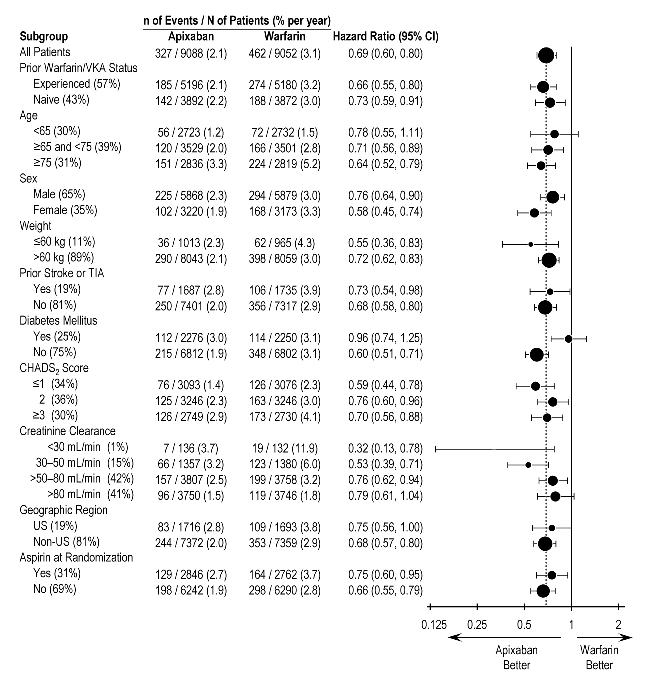
In the ARISTOTLE study, results for major bleeding were mostly the same across most major subgroups. These included age, weight, CHADS2 score, prior warfarin use, geographic region, and aspirin use at randomization. CHADS2 is a scale from 0 to 6 used to estimate stroke risk. Higher scores mean greater risk.
In ARISTOTLE, people treated with ELIQUIS who had diabetes bled more (3% per year) than people without diabetes (1.9% per year).
Events for each endpoint were counted once per person. But a person could have events in more than one endpoint.
Fewer than 1% of patients taking ELIQUIS had allergic reactions. These included drug allergy such as skin rash, and severe allergic reactions such as swelling. Fewer than 1% also fainted.
The safety of ELIQUIS was studied in 1 Phase II study and 3 Phase III studies. These included 5924 patients who had major bone surgery of the lower limbs. The surgery was elective hip or knee replacement. They took ELIQUIS 2.5 mg twice daily for up to 38 days.
ELIQUIS was studied in 1 Phase II study and 3 Phase III studies. These studies included 5924 patients. The patients had major orthopedic surgery of the lower limbs. This means elective hip replacement or elective knee replacement. They took ELIQUIS 2.5 mg twice daily. They were treated for up to 38 days.
In total, 11% of the patients treated with ELIQUIS 2.5 mg twice daily had adverse reactions.
Bleeding results during the treatment period in the Phase III studies are shown in Table 4. Bleeding was checked in each study starting with the first dose of double-blind study drug.
Table 4 reports bleeding during the treatment period in patients having elective hip or knee replacement surgery. All bleeding criteria included bleeding at the surgical site.
Table 4 footnote † includes 13 subjects with major bleeding events that happened before the first dose of ELIQUIS. ELIQUIS was given 12 to 24 hours after surgery.
Table 4 footnote ‡ includes 5 subjects with major bleeding events that happened before the first dose of ELIQUIS. ELIQUIS was given 12 to 24 hours after surgery.
Table 4 footnote § defines major bleeding to include: intracranial bleeding; intraspinal bleeding; intraocular bleeding; pericardial bleeding; an operated joint that needed re-operation or intervention; intramuscular bleeding with compartment syndrome; or retroperitoneal bleeding. Bleeding into an operated joint that needed re-operation or intervention was present in all patients with this category of bleeding. Events and event rates include one enoxaparin-treated patient in ADVANCE-1 who also had intracranial hemorrhage.
CRNM = clinically relevant nonmajor.
Adverse reactions occurring in ≥1% of patients having hip or knee replacement surgery in the 1 Phase II study and the 3 Phase III studies are listed in Table 5. Table 5 reports adverse reactions occurring in ≥1% of patients in either group having hip or knee replacement surgery.
- Anemia (including postoperative and hemorrhagic anemia, and respective laboratory parameters) occurred in 153 (2.6) patients in one group and 178 (3.0) patients in the other group.
- Postprocedural hemorrhage (including postprocedural hematoma, wound hemorrhage, vessel puncture-site hematoma, and catheter-site hemorrhage) occurred in 54 (0.9) patients in one group and 60 (1.0) patients in the other group.
- Transaminases increased (including alanine aminotransferase increased and alanine aminotransferase abnormal) occurred in 50 (0.8) patients in one group and 71 (1.2) patients in the other group.
Less common adverse reactions in ELIQUIS-treated patients having hip or knee replacement surgery occurred at a frequency of ≥0.1% to <1%:
- Blood and lymphatic system disorders: thrombocytopenia (including platelet count decreases) occurred as a less common adverse reaction in ELIQUIS-treated patients having hip or knee replacement surgery at a frequency of ≥0.1% to <1%.
- Vascular disorders: hypotension (including procedural hypotension) occurred as a less common adverse reaction in ELIQUIS-treated patients having hip or knee replacement surgery at a frequency of ≥0.1% to <1%.
- Respiratory, thoracic, and mediastinal disorders: epistaxis occurred as a less common adverse reaction in ELIQUIS-treated patients having hip or knee replacement surgery at a frequency of ≥0.1% to <1%.
- Gastrointestinal disorders: gastrointestinal hemorrhage (including hematemesis and melena) occurred as a less common adverse reaction in ELIQUIS-treated patients having hip or knee replacement surgery at a frequency of ≥0.1% to <1%.
- Gastrointestinal disorders: hematochezia occurred as a less common adverse reaction in ELIQUIS-treated patients having hip or knee replacement surgery at a frequency of ≥0.1% to <1%.
These side effects were reported in people taking ELIQUIS.
- Stomach and intestine problems: bleeding in the stomach or gut, throwing up blood, black stools, and bright red blood in stool.
- Liver problems: abnormal liver blood test, higher alkaline phosphatase in the blood, and higher bilirubin in the blood.
- Kidney and bladder problems: blood in the urine, including lab test changes.
- Injury and procedure problems: fluid leaking from a wound, bleeding at the incision site (including a collection of blood at the incision site), and bleeding during surgery.
Less common side effects in ELIQUIS-treated patients having hip or knee replacement surgery happened in less than 0.1% of patients.
- Bleeding gums.
- Coughing up blood.
- Allergic reaction.
- Bleeding in muscle.
- Bleeding in the eye, including bleeding in the clear lining of the eye.
- Bleeding from the rectum.
The safety of ELIQUIS was studied in the AMPLIFY and AMPLIFY-EXT studies.
These studies included 2676 patients who took ELIQUIS 10 mg twice daily.
They included 3359 patients who took ELIQUIS 5 mg twice daily.
They included 840 patients who took ELIQUIS 2.5 mg twice daily.
Common side effects (1% or more) were bleeding gums, nosebleeds, bruising, blood in the urine, bleeding from the rectum, a collection of blood under the skin, heavy menstrual bleeding, and coughing up blood.
In the AMPLIFY study, patients took ELIQUIS for an average of 154 days.
Patients took enoxaparin/warfarin for an average of 152 days.
Bleeding-related side effects happened in 417 (15.6%) patients taking ELIQUIS.
They happened in 661 (24.6%) patients taking enoxaparin/warfarin.
In the AMPLIFY study, 0.7% of patients taking ELIQUIS stopped treatment because of bleeding.
In that study, 1.7% of patients taking enoxaparin/warfarin stopped treatment because of bleeding.
In the AMPLIFY study, ELIQUIS was statistically superior to enoxaparin/warfarin for the main safety endpoint of major bleeding.
The relative risk was 0.31, with a 95% confidence interval of 0.17 to 0.55, and a P-value less than 0.0001.
Table 6 presents bleeding results in the AMPLIFY study.
CRNM stands for clinically relevant nonmajor bleeding.
Adverse reactions occurring in 1% or more of patients in the AMPLIFY study are listed in Table 7.
Table 7 lists adverse reactions occurring in 1% or more of patients treated for DVT and PE in the AMPLIFY study.
In the AMPLIFY-EXT study, patients took ELIQUIS for about 330 days on average. Patients took placebo for 312 days on average.
In that study, bleeding-related side effects happened in 219 ELIQUIS patients (13.3%). They happened in 72 placebo patients (8.7%).
About 1% of ELIQUIS patients stopped treatment because of bleeding. About 0.4% of placebo patients stopped because of bleeding.
Bleeding results from the AMPLIFY-EXT study are in Table 8.
Table 8: Bleeding Results in the AMPLIFY-EXT Study.
Side effects that happened in 1% or more of patients in the AMPLIFY-EXT study are in Table 9.
Table 9: Side Effects in 1% or More of Patients Getting Extended Treatment for DVT and PE in the AMPLIFY-EXT Study.
Less common side effects in ELIQUIS patients in the AMPLIFY or AMPLIFY-EXT studies happened in 0.1% to less than 1% of patients.
- Blood and lymphatic system: low red blood cells from bleeding (hemorrhagic anemia).
- Stomach and bowel: blood in stool (hematochezia), bleeding from hemorrhoids, stomach or bowel bleeding, vomiting blood (hematemesis), black tarry stool (melena), bleeding from the anus.
- Injury, poisoning, and procedure problems: bleeding from a wound, bleeding after a procedure, bruising from trauma, bruising around the eye.
- Muscles and connective tissue: muscle bleeding.
- Reproductive system and breast: vaginal bleeding, irregular uterine bleeding (metrorrhagia), heavy and irregular uterine bleeding (menometrorrhagia), genital bleeding.
- Blood vessels: bleeding.
- Skin: bruising (ecchymosis), skin bleeding, small red or purple spots on the skin (petechiae).
- Eyes: bleeding in the clear lining of the eye (conjunctival hemorrhage), bleeding in the back of the eye (retinal hemorrhage), eye bleeding.
- Lab tests: blood in urine, a positive test for hidden blood, hidden blood, red blood cells in urine.
The safety of ELIQUIS was studied in CV185325. This was a phase 3 study in 225 patients from birth and older.
Patients were put into groups by chance in a 2:1 ratio. One group got ELIQUIS in a form suited to their age, at doses adjusted for body weight. The other group got standard care.
Standard care treatments were unfractionated heparin (UFH), low molecular weight heparin (LMWH), or vitamin K antagonist (VKA).
In children from birth and older, the safety profile of ELIQUIS was generally like that in adults. It was also consistent across different child age groups.
- In children, too much menstrual bleeding happened in 17 (11%) patients taking ELIQUIS and 3 (4%) patients getting standard care.
- Nosebleeds happened in 24 (16%) patients taking ELIQUIS and 14 (19%) patients getting standard care.
- General disorders and administration-site conditions: injection-site hematoma (a bruise where the shot was given).
- General disorders and administration-site conditions: vessel puncture-site hematoma (a bruise where a blood vessel was punctured).
Bleeding results from Study CV185325 in children with VTE are shown in Table 10.
Table 10: Bleeding Results in Study CV185325 – Safety Analysis Set – Main Phase.
CRNM means clinically relevant nonmajor bleeding.
(1) The 95% confidence interval was calculated using the Clopper-Pearson exact method.
Events for each endpoint were counted once per subject. But subjects may have had events in more than one endpoint.
- UFH/LMWH was used for patients under 2 years of age. UFH/LMWH/VKA was used for patients 2 years of age and older.
Non-bleeding side effects that happened in 10% or more of patients in study CV185325 are listed in Table 11.
Table 11: Other Adverse Reactions Occurring in 10% or More of Patients in Study CV185325.
| ELIQUIS
N=9088 n (per 100 pt-year) |
Warfarin
N=9052 n (per 100 pt-year) |
Hazard Ratio
(95% CI) |
P-value | |
|---|---|---|---|---|
| * Bleeding events within each subcategory were counted once per subject, but subjects may have contributed events to multiple endpoints. Bleeding events were counted during treatment or within 2 days of stopping study treatment (on-treatment period). | ||||
| † Defined as clinically overt bleeding accompanied by one or more of the following: a decrease in hemoglobin of ≥2 g/dL, a transfusion of 2 or more units of packed red blood cells, bleeding at a critical site: intracranial, intraspinal, intraocular, pericardial, intra-articular, intramuscular with compartment syndrome, retroperitoneal or with fatal outcome. | ||||
| ‡ Intracranial bleed includes intracerebral, intraventricular, subdural, and subarachnoid bleeding. Any type of hemorrhagic stroke was adjudicated and counted as an intracranial major bleed. | ||||
| § On-treatment analysis based on the safety population, compared to ITT analysis presented in Section 14. | ||||
| ¶ GI bleed includes upper GI, lower GI, and rectal bleeding. | ||||
| ** Fatal bleeding is an adjudicated death with the primary cause of death as intracranial bleeding or non-intracranial bleeding during the on-treatment period. | ||||
|
Major† |
327 (2.13) |
462 (3.09) |
0.69 (0.60, 0.80) |
<0.0001 |
|
Intracranial (ICH)‡ |
52 (0.33) |
125 (0.82) |
0.41 (0.30, 0.57) |
– |
|
Hemorrhagic stroke§ |
38 (0.24) |
74 (0.49) |
0.51 (0.34, 0.75) |
– |
|
Other ICH |
15 (0.10) |
51 (0.34) |
0.29 (0.16, 0.51) |
– |
|
Gastrointestinal (GI)¶ |
128 (0.83) |
141 (0.93) |
0.89 (0.70, 1.14) |
– |
|
Fatal** |
10 (0.06) |
37 (0.24) |
0.27 (0.13, 0.53) |
– |
|
Intracranial |
4 (0.03) |
30 (0.20) |
0.13 (0.05, 0.37) |
– |
|
Non-intracranial |
6 (0.04) |
7 (0.05) |
0.84 (0.28, 2.15) |
– |
| ELIQUIS
N=2798 n (%/year) |
Aspirin
N=2780 n (%/year) |
Hazard Ratio
(95% CI) |
P-value | |
|---|---|---|---|---|
|
Major |
45 (1.41) |
29 (0.92) |
1.54 (0.96, 2.45) |
0.07 |
|
Fatal |
5 (0.16) |
5 (0.16) |
0.99 (0.23, 4.29) |
– |
|
Intracranial |
11 (0.34) |
11 (0.35) |
0.99 (0.39, 2.51) |
– |
| Bleeding Endpoint* | ADVANCE-3
Hip Replacement Surgery |
ADVANCE-2
Knee Replacement Surgery |
ADVANCE-1
Knee Replacement Surgery |
|||
|---|---|---|---|---|---|---|
| * All bleeding criteria included surgical site bleeding. | ||||||
| † Includes 13 subjects with major bleeding events that occurred before the first dose of ELIQUIS (administered 12 to 24 hours post surgery). | ||||||
| ‡ Includes 5 subjects with major bleeding events that occurred before the first dose of ELIQUIS (administered 12 to 24 hours post surgery). | ||||||
| § Intracranial, intraspinal, intraocular, pericardial, an operated joint requiring re-operation or intervention, intramuscular with compartment syndrome, or retroperitoneal. Bleeding into an operated joint requiring re-operation or intervention was present in all patients with this category of bleeding. Events and event rates include one enoxaparin-treated patient in ADVANCE-1 who also had intracranial hemorrhage. | ||||||
| ¶ CRNM = clinically relevant nonmajor. | ||||||
|
ELIQUIS 2.5 mg po bid 35±3 days |
Enoxaparin 40 mg sc qd 35±3 days |
ELIQUIS 2.5 mg po bid 12±2 days |
Enoxaparin 40 mg sc qd 12±2 days |
ELIQUIS 2.5 mg po bid 12±2 days |
Enoxaparin 30 mg sc q12h 12±2 days |
|
|
First dose 12 to 24 hours post surgery |
First dose 9 to 15 hours prior to surgery |
First dose 12 to 24 hours post surgery |
First dose 9 to 15 hours prior to surgery |
First dose 12 to 24 hours post surgery |
|
|
All treated |
N=2673 |
N=2659 |
N=1501 |
N=1508 |
N=1596 |
N=1588 |
|
Major (including surgical site) |
22 (0.82%)† |
18 (0.68%) |
9 (0.60%)‡ |
14 (0.93%) |
11 (0.69%) |
22 (1.39%) |
|
Fatal |
0 |
0 |
0 |
0 |
0 |
1 (0.06%) |
|
Hgb decrease ≥2 g/dL |
13 (0.49%) |
10 (0.38%) |
8 (0.53%) |
9 (0.60%) |
10 (0.63%) |
16 (1.01%) |
|
Transfusion of ≥2 units RBC |
16 (0.60%) |
14 (0.53%) |
5 (0.33%) |
9 (0.60%) |
9 (0.56%) |
18 (1.13%) |
|
Bleed at critical site§ |
1 (0.04%) |
1 (0.04%) |
1 (0.07%) |
2 (0.13%) |
1 (0.06%) |
4 (0.25%) |
|
Major + CRNM¶ |
129 (4.83%) |
134 (5.04%) |
53 (3.53%) |
72 (4.77%) |
46 (2.88%) |
68 (4.28%) |
|
All |
313 (11.71%) |
334 (12.56%) |
104 (6.93%) |
126 (8.36%) |
85 (5.33%) |
108 (6.80%) |
| ELIQUIS, n (%)
2.5 mg po bid N=5924 |
Enoxaparin, n (%)
40 mg sc qd or 30 mg sc q12h N=5904 |
|
|---|---|---|
|
Nausea |
153 (2.6) |
159 (2.7) |
|
Anemia (including postoperative and hemorrhagic anemia, and respective laboratory parameters) |
153 (2.6) |
178 (3.0) |
|
Contusion |
83 (1.4) |
115 (1.9) |
|
Hemorrhage (including hematoma, and vaginal and urethral hemorrhage) |
67 (1.1) |
81 (1.4) |
|
Postprocedural hemorrhage (including postprocedural hematoma, wound hemorrhage, vessel puncture-site hematoma, and catheter-site hemorrhage) |
54 (0.9) |
60 (1.0) |
|
Transaminases increased (including alanine aminotransferase increased and alanine aminotransferase abnormal) |
50 (0.8) |
71 (1.2) |
|
Aspartate aminotransferase increased |
47 (0.8) |
69 (1.2) |
|
Gamma-glutamyltransferase increased |
38 (0.6) |
65 (1.1) |
| * CRNM = clinically relevant nonmajor bleeding. | |||
| Events associated with each endpoint were counted once per subject, but subjects may have contributed events to multiple endpoints. | |||
|
ELIQUIS N=2676 n (%) |
Enoxaparin/Warfarin N=2689 n (%) |
Relative Risk (95% CI) |
|
|
Major |
15 (0.6) |
49 (1.8) |
0.31 (0.17, 0.55) p<0.0001 |
|
CRNM* |
103 (3.9) |
215 (8.0) |
|
|
Major + CRNM |
115 (4.3) |
261 (9.7) |
|
|
Minor |
313 (11.7) |
505 (18.8) |
|
|
All |
402 (15.0) |
676 (25.1) |
|
|
ELIQUIS N=2676 n (%) |
Enoxaparin/Warfarin N=2689 n (%) |
|
|
Epistaxis |
77 (2.9) |
146 (5.4) |
|
Contusion |
49 (1.8) |
97 (3.6) |
|
Hematuria |
46 (1.7) |
102 (3.8) |
|
Menorrhagia |
38 (1.4) |
30 (1.1) |
|
Hematoma |
35 (1.3) |
76 (2.8) |
|
Hemoptysis |
32 (1.2) |
31 (1.2) |
|
Rectal hemorrhage |
26 (1.0) |
39 (1.5) |
|
Gingival bleeding |
26 (1.0) |
50 (1.9) |
| * CRNM = clinically relevant nonmajor bleeding. | |||
| Events associated with each endpoint were counted once per subject, but subjects may have contributed events to multiple endpoints. | |||
|
ELIQUIS 2.5 mg bid N=840 n (%) |
ELIQUIS 5 mg bid N=811 n (%) |
Placebo N=826 n (%) |
|
|
Major |
2 (0.2) |
1 (0.1) |
4 (0.5) |
|
CRNM* |
25 (3.0) |
34 (4.2) |
19 (2.3) |
|
Major + CRNM |
27 (3.2) |
35 (4.3) |
22 (2.7) |
|
Minor |
75 (8.9) |
98 (12.1) |
58 (7.0) |
|
All |
94 (11.2) |
121 (14.9) |
74 (9.0) |
|
ELIQUIS 2.5 mg bid N=840 n (%) |
ELIQUIS 5 mg bid N=811 n (%) |
Placebo N=826 n (%) |
|
|
Epistaxis |
13 (1.5) |
29 (3.6) |
9 (1.1) |
|
Hematuria |
12 (1.4) |
17 (2.1) |
9 (1.1) |
|
Hematoma |
13 (1.5) |
16 (2.0) |
10 (1.2) |
|
Contusion |
18 (2.1) |
18 (2.2) |
18 (2.2) |
|
Gingival bleeding |
12 (1.4) |
9 (1.1) |
3 (0.4) |
| * CRNM = clinically relevant nonmajor bleeding. | ||
| (1) 95% Confidence Interval calculated using the Clopper-Pearson exact method | ||
| Events associated with each endpoint were counted once per subject, but subjects may have contributed events to multiple endpoints. | ||
| ** UFH/LMWH for patients less than 2 years of age and UFH/LMWH/VKA for those equal to or greater than 2 years of age. | ||
|
ELIQUIS N=152
|
Standard of care ** N=73
|
|
|
Major Bleeding |
||
|
Number (%) Subjects with Event 95% Confidence Interval (1) |
0 |
0 |
|
CRNM* |
||
|
Number (%) Subjects with Event |
2 (1.3) |
1 (1.4) |
|
95% Confidence Interval (1) |
(0.2, 4.7) |
(0.0, 7.4) |
|
Minor Bleeding |
||
|
Number (%) Subjects with Event |
54 (35.5) |
21 (28.8) |
|
95% Confidence Interval (1) |
(27.9, 43.7) |
(18.8, 40.6) |
|
All |
||
|
Number (%) Subjects with Event |
55 (36.2) |
21 (28.8) |
|
95% Confidence Interval (1) |
(28.6, 44.4) |
(18.8, 40.6) |
|
Number of Subjects Evaluable for Adverse Reaction |
ELIQUIS N=152 n (%) |
Standard of Care N=73 n (%) |
|
Headache |
25 (16.4) |
11 (15.1) |
|
Vomiting |
21 (13.8) |
5 (6.8) |
The following clinically significant adverse reactions are discussed in greater detail in other sections of the prescribing information.
• Increased Risk of Thrombotic Events After Premature Discontinuation [see Warnings and Precautions (5.1) ]
• Bleeding [see Warnings and Precautions (5.2) ]
• Spinal/Epidural Anesthesia or Puncture [see Warnings and Precautions (5.3) ]
6.1 Clinical Trials Experience
Adult Patients
Because clinical trials are conducted under widely varying conditions, adverse reaction rates observed in the clinical trials of a drug cannot be directly compared to rates in the clinical trials of another drug and may not reflect the rates observed in practice.
Reduction of Risk of Stroke and Systemic Embolism in Patients with Nonvalvular Atrial Fibrillation
The safety of ELIQUIS was evaluated in the ARISTOTLE and AVERROES studies [see Clinical Studies (14) ], including 11,284 patients exposed to ELIQUIS 5 mg twice daily and 602 patients exposed to ELIQUIS 2.5 mg twice daily. The duration of ELIQUIS exposure was ≥12 months for 9375 patients and ≥24 months for 3369 patients in the two studies. In ARISTOTLE, the mean duration of exposure was 89 weeks (>15,000 patient-years). In AVERROES, the mean duration of exposure was approximately 59 weeks (>3000 patient-years).
The most common reason for treatment discontinuation in both studies was for bleeding-related adverse reactions; in ARISTOTLE this occurred in 1.7% and 2.5% of patients treated with ELIQUIS and warfarin, respectively, and in AVERROES, in 1.5% and 1.3% on ELIQUIS and aspirin, respectively.
Bleeding in Patients with Nonvalvular Atrial Fibrillation in ARISTOTLE and AVERROES
Tables 2 and 3 show the number of patients experiencing major bleeding during the treatment period and the bleeding rate (percentage of subjects with at least one bleeding event per 100 patient-years) in ARISTOTLE and AVERROES.
| ELIQUIS N=9088 n (per 100 pt-year) |
Warfarin N=9052 n (per 100 pt-year) |
Hazard Ratio (95% CI) |
P-value | |
|---|---|---|---|---|
| * Bleeding events within each subcategory were counted once per subject, but subjects may have contributed events to multiple endpoints. Bleeding events were counted during treatment or within 2 days of stopping study treatment (on-treatment period). | ||||
| † Defined as clinically overt bleeding accompanied by one or more of the following: a decrease in hemoglobin of ≥2 g/dL, a transfusion of 2 or more units of packed red blood cells, bleeding at a critical site: intracranial, intraspinal, intraocular, pericardial, intra-articular, intramuscular with compartment syndrome, retroperitoneal or with fatal outcome. | ||||
| ‡ Intracranial bleed includes intracerebral, intraventricular, subdural, and subarachnoid bleeding. Any type of hemorrhagic stroke was adjudicated and counted as an intracranial major bleed. | ||||
| § On-treatment analysis based on the safety population, compared to ITT analysis presented in Section 14. | ||||
| ¶ GI bleed includes upper GI, lower GI, and rectal bleeding. | ||||
| ** Fatal bleeding is an adjudicated death with the primary cause of death as intracranial bleeding or non-intracranial bleeding during the on-treatment period. | ||||
|
Major† |
327 (2.13) |
462 (3.09) |
0.69 (0.60, 0.80) |
<0.0001 |
|
Intracranial (ICH)‡ |
52 (0.33) |
125 (0.82) |
0.41 (0.30, 0.57) |
– |
|
Hemorrhagic stroke§ |
38 (0.24) |
74 (0.49) |
0.51 (0.34, 0.75) |
– |
|
Other ICH |
15 (0.10) |
51 (0.34) |
0.29 (0.16, 0.51) |
– |
|
Gastrointestinal (GI)¶ |
128 (0.83) |
141 (0.93) |
0.89 (0.70, 1.14) |
– |
|
Fatal** |
10 (0.06) |
37 (0.24) |
0.27 (0.13, 0.53) |
– |
|
Intracranial |
4 (0.03) |
30 (0.20) |
0.13 (0.05, 0.37) |
– |
|
Non-intracranial |
6 (0.04) |
7 (0.05) |
0.84 (0.28, 2.15) |
– |
| ELIQUIS N=2798 n (%/year) |
Aspirin N=2780 n (%/year) |
Hazard Ratio (95% CI) |
P-value | |
|---|---|---|---|---|
|
Major |
45 (1.41) |
29 (0.92) |
1.54 (0.96, 2.45) |
0.07 |
|
Fatal |
5 (0.16) |
5 (0.16) |
0.99 (0.23, 4.29) |
– |
|
Intracranial |
11 (0.34) |
11 (0.35) |
0.99 (0.39, 2.51) |
– |
| Bleeding Endpoint* | ADVANCE-3 Hip Replacement Surgery |
ADVANCE-2 Knee Replacement Surgery |
ADVANCE-1 Knee Replacement Surgery |
|||
|---|---|---|---|---|---|---|
| * All bleeding criteria included surgical site bleeding. | ||||||
| † Includes 13 subjects with major bleeding events that occurred before the first dose of ELIQUIS (administered 12 to 24 hours post surgery). | ||||||
| ‡ Includes 5 subjects with major bleeding events that occurred before the first dose of ELIQUIS (administered 12 to 24 hours post surgery). | ||||||
| § Intracranial, intraspinal, intraocular, pericardial, an operated joint requiring re-operation or intervention, intramuscular with compartment syndrome, or retroperitoneal. Bleeding into an operated joint requiring re-operation or intervention was present in all patients with this category of bleeding. Events and event rates include one enoxaparin-treated patient in ADVANCE-1 who also had intracranial hemorrhage. | ||||||
| ¶ CRNM = clinically relevant nonmajor. | ||||||
|
ELIQUIS |
Enoxaparin |
ELIQUIS |
Enoxaparin |
ELIQUIS |
Enoxaparin |
|
|
First dose |
First dose |
First dose |
First dose |
First dose |
First dose |
|
|
All treated |
N=2673 |
N=2659 |
N=1501 |
N=1508 |
N=1596 |
N=1588 |
|
Major (including surgical site) |
22 (0.82%)† |
18 (0.68%) |
9 (0.60%)‡ |
14 (0.93%) |
11 (0.69%) |
22 (1.39%) |
|
Fatal |
0 |
0 |
0 |
0 |
0 |
1 (0.06%) |
|
Hgb decrease ≥2 g/dL |
13 (0.49%) |
10 (0.38%) |
8 (0.53%) |
9 (0.60%) |
10 (0.63%) |
16 (1.01%) |
|
Transfusion of ≥2 units RBC |
16 (0.60%) |
14 (0.53%) |
5 (0.33%) |
9 (0.60%) |
9 (0.56%) |
18 (1.13%) |
|
Bleed at critical site§ |
1 (0.04%) |
1 (0.04%) |
1 (0.07%) |
2 (0.13%) |
1 (0.06%) |
4 (0.25%) |
|
Major |
129 (4.83%) |
134 (5.04%) |
53 (3.53%) |
72 (4.77%) |
46 (2.88%) |
68 (4.28%) |
|
All |
313 (11.71%) |
334 (12.56%) |
104 (6.93%) |
126 (8.36%) |
85 (5.33%) |
108 (6.80%) |
| ELIQUIS, n (%) 2.5 mg po bid N=5924 |
Enoxaparin, n (%) 40 mg sc qd or 30 mg sc q12h N=5904 |
|
|---|---|---|
|
Nausea |
153 (2.6) |
159 (2.7) |
|
Anemia (including postoperative and hemorrhagic anemia, and respective laboratory parameters) |
153 (2.6) |
178 (3.0) |
|
Contusion |
83 (1.4) |
115 (1.9) |
|
Hemorrhage (including hematoma, and vaginal and urethral hemorrhage) |
67 (1.1) |
81 (1.4) |
|
Postprocedural hemorrhage (including postprocedural hematoma, wound hemorrhage, vessel puncture-site hematoma, and catheter-site hemorrhage) |
54 (0.9) |
60 (1.0) |
|
Transaminases increased (including alanine aminotransferase increased and alanine aminotransferase abnormal) |
50 (0.8) |
71 (1.2) |
|
Aspartate aminotransferase increased |
47 (0.8) |
69 (1.2) |
|
Gamma-glutamyltransferase increased |
38 (0.6) |
65 (1.1) |
| * CRNM = clinically relevant nonmajor bleeding. | |||
| Events associated with each endpoint were counted once per subject, but subjects may have contributed events to multiple endpoints. | |||
|
ELIQUIS |
Enoxaparin/Warfarin |
Relative Risk (95% CI) |
|
|
Major |
15 (0.6) |
49 (1.8) |
0.31 (0.17, 0.55) |
|
CRNM* |
103 (3.9) |
215 (8.0) |
|
|
Major + CRNM |
115 (4.3) |
261 (9.7) |
|
|
Minor |
313 (11.7) |
505 (18.8) |
|
|
All |
402 (15.0) |
676 (25.1) |
|
|
ELIQUIS |
Enoxaparin/Warfarin |
|
|
Epistaxis |
77 (2.9) |
146 (5.4) |
|
Contusion |
49 (1.8) |
97 (3.6) |
|
Hematuria |
46 (1.7) |
102 (3.8) |
|
Menorrhagia |
38 (1.4) |
30 (1.1) |
|
Hematoma |
35 (1.3) |
76 (2.8) |
|
Hemoptysis |
32 (1.2) |
31 (1.2) |
|
Rectal hemorrhage |
26 (1.0) |
39 (1.5) |
|
Gingival bleeding |
26 (1.0) |
50 (1.9) |
| * CRNM = clinically relevant nonmajor bleeding. | |||
| Events associated with each endpoint were counted once per subject, but subjects may have contributed events to multiple endpoints. | |||
|
ELIQUIS 2.5 mg bid |
ELIQUIS 5 mg bid |
Placebo |
|
|
Major |
2 (0.2) |
1 (0.1) |
4 (0.5) |
|
CRNM* |
25 (3.0) |
34 (4.2) |
19 (2.3) |
|
Major + CRNM |
27 (3.2) |
35 (4.3) |
22 (2.7) |
|
Minor |
75 (8.9) |
98 (12.1) |
58 (7.0) |
|
All |
94 (11.2) |
121 (14.9) |
74 (9.0) |
|
ELIQUIS 2.5 mg bid |
ELIQUIS 5 mg bid |
Placebo |
|
|
Epistaxis |
13 (1.5) |
29 (3.6) |
9 (1.1) |
|
Hematuria |
12 (1.4) |
17 (2.1) |
9 (1.1) |
|
Hematoma |
13 (1.5) |
16 (2.0) |
10 (1.2) |
|
Contusion |
18 (2.1) |
18 (2.2) |
18 (2.2) |
|
Gingival bleeding |
12 (1.4) |
9 (1.1) |
3 (0.4) |
| * CRNM = clinically relevant nonmajor bleeding. | ||
| (1) 95% Confidence Interval calculated using the Clopper-Pearson exact method | ||
| Events associated with each endpoint were counted once per subject, but subjects may have contributed events to multiple endpoints. | ||
| ** UFH/LMWH for patients less than 2 years of age and UFH/LMWH/VKA for those equal to or greater than 2 years of age. | ||
|
ELIQUIS |
Standard of care ** |
|
|
Major Bleeding |
||
|
Number (%) Subjects with Event 95% Confidence Interval (1) |
0 |
0 |
|
CRNM* |
||
|
Number (%) Subjects with Event |
2 (1.3) |
1 (1.4) |
|
95% Confidence Interval (1) |
(0.2, 4.7) |
(0.0, 7.4) |
|
Minor Bleeding |
||
|
Number (%) Subjects with Event |
54 (35.5) |
21 (28.8) |
|
95% Confidence Interval (1) |
(27.9, 43.7) |
(18.8, 40.6) |
|
All |
||
|
Number (%) Subjects with Event |
55 (36.2) |
21 (28.8) |
|
95% Confidence Interval (1) |
(28.6, 44.4) |
(18.8, 40.6) |
|
Number of Subjects Evaluable for Adverse Reaction |
ELIQUIS |
Standard of Care |
|
Headache |
25 (16.4) |
11 (15.1) |
|
Vomiting |
21 (13.8) |
5 (6.8) |

Drug Interactions (What to Avoid)
Some medicines can change how ELIQUIS works in your body. These are called combined P-gp and strong CYP3A4 inhibitors or inducers. Your doctor may change your ELIQUIS dose or tell you to avoid these medicines.
- If you take ELIQUIS 5 mg or 10 mg two times a day, your doctor should lower your ELIQUIS dose by half when you also take a combined P-gp and strong CYP3A4 inhibitor. Examples are ketoconazole, itraconazole, and ritonavir.
- If you take ELIQUIS 2.5 mg two times a day, avoid taking a combined P-gp and strong CYP3A4 inhibitor at the same time.
- Taking a combined P-gp and strong CYP3A4 inhibitor with ELIQUIS has not been studied in children.
- Apixaban is the active drug in ELIQUIS. It is broken down by CYP3A4 and P-gp in the body.
- Taking a combined P-gp and strong CYP3A4 inhibitor with ELIQUIS raises the amount of apixaban in your body. This raises your risk of bleeding.
- Clarithromycin is a combined P-gp and strong CYP3A4 inhibitor. But study data suggest you do not need a dose change when you take it with ELIQUIS.
- Avoid taking ELIQUIS with combined P-gp and strong CYP3A4 inducers. Examples are rifampin, carbamazepine, phenytoin, and St. John’s wort.
- Combined P-gp and strong CYP3A4 inducers lower the amount of apixaban in your body. This raises your risk of stroke and other blood clot events.
- Taking antiplatelet agents, fibrinolytics, heparin, aspirin, or long-term NSAIDs with ELIQUIS raises your risk of bleeding.
- In the APPRAISE-2 trial, ELIQUIS was compared with placebo in high-risk patients after acute coronary syndrome who took aspirin or aspirin plus clopidogrel. The trial was stopped early because more bleeding happened with ELIQUIS than with placebo.
- In APPRAISE-2, the rate of ISTH major bleeding was 2.8% per year with ELIQUIS and 0.6% per year with placebo in patients taking one antiplatelet drug.
- In APPRAISE-2, the rate of ISTH major bleeding was 5.9% per year with ELIQUIS and 2.5% per year with placebo in patients taking two antiplatelet drugs.
- In the ARISTOTLE trial, taking aspirin with ELIQUIS raised the bleeding risk from 1.8% per year to 3.4% per year.
- In the ARISTOTLE trial, taking aspirin and warfarin with ELIQUIS raised the bleeding risk from 2.7% per year to 4.6% per year.
- In the ARISTOTLE trial, only a small number of patients (2.3%) took two antiplatelet drugs with ELIQUIS.
7.1 Combined P-gp and Strong CYP3A4 Inhibitors
For patients receiving ELIQUIS 5 mg or 10 mg twice daily, the dose of ELIQUIS should be decreased by 50% when coadministered with drugs that are combined P-gp and strong CYP3A4 inhibitors (e.g., ketoconazole, itraconazole, ritonavir) [see Dosage and Administration (2.6) and Clinical Pharmacology (12.3) ].
For patients receiving ELIQUIS at a dose of 2.5 mg twice daily, avoid coadministration with combined P-gp and strong CYP3A4 inhibitors [see Dosage and Administration (2.6) and Clinical Pharmacology (12.3) ].
Concomitant administration of combined P-gp and strong CYP3A4 inhibitors has not been studied in pediatric patients.
Apixaban is a substrate of both CYP3A4 and P-gp. Concomitant use with drugs that are combined P-gp and strong CYP3A4 inhibitors increases exposure to apixaban [see Clinical Pharmacology (12.3) ] which increases the risk for bleeding.
Clarithromycin
Although clarithromycin is a combined P-gp and strong CYP3A4 inhibitor, pharmacokinetic data suggest that no dose adjustment is necessary with concomitant administration with ELIQUIS [see Clinical Pharmacology (12.3) ].
7.2 Combined P-gp and Strong CYP3A4 Inducers
Avoid concomitant use of ELIQUIS with combined P-gp and strong CYP3A4 inducers (e.g., rifampin, carbamazepine, phenytoin, St. John’s wort) because such drugs will decrease exposure to apixaban [see Clinical Pharmacology (12.3) ].
Apixaban is a substrate of both CYP3A4 and P-gp. Concomitant use with drugs that are combined P-gp and strong CYP3A4 inducers decreases exposure to apixaban [see Clinical Pharmacology (12.3) ] which increases the risk for stroke and other thromboembolic events.
7.3 Anticoagulants and Antiplatelet Agents
Coadministration of antiplatelet agents, fibrinolytics, heparin, aspirin, and chronic NSAID use increases the risk of bleeding.
APPRAISE-2, a placebo-controlled clinical trial of ELIQUIS in high-risk, post-acute coronary syndrome patients treated with aspirin or the combination of aspirin and clopidogrel, was terminated early due to a higher rate of bleeding with ELIQUIS compared to placebo. The rate of ISTH major bleeding was 2.8% per year with ELIQUIS versus 0.6% per year with placebo in patients receiving single antiplatelet therapy and was 5.9% per year with ELIQUIS versus 2.5% per year with placebo in those receiving dual antiplatelet therapy.
In ARISTOTLE, concomitant use of aspirin increased the bleeding risk on ELIQUIS from 1.8% per year to 3.4% per year and concomitant use of aspirin and warfarin increased the bleeding risk from 2.7% per year to 4.6% per year. In this clinical trial, there was limited (2.3%) use of dual antiplatelet therapy with ELIQUIS.
Use in Pregnancy
There is not enough information on ELIQUIS use in pregnant women. We do not know if it raises the risk of major birth defects, miscarriage, or other problems with development.
Treatment may raise the risk of bleeding during pregnancy and delivery.
In animal studies, no bad effects on development were seen in rats (by mouth), rabbits (into a vein), or mice (by mouth) during organ growth. These studies used apixaban amounts up to 4, 1, and 19 times the human amount. The human amount is based on the area under the plasma-concentration time curve (AUC) at the maximum recommended human dose (MRHD) of 5 mg twice a day.
The background risk of major birth defects and miscarriage for the indicated groups is not known.
All pregnancies have a background risk of birth defects, loss, or other bad outcomes.
In the U.S. general population, the estimated background risk of major birth defects in recognized pregnancies is 2% to 4%. The estimated background risk of miscarriage is 15% to 20%.
Pregnancy raises the risk of thromboembolism. This risk is higher for women who have thromboembolic disease or certain high-risk pregnancy conditions.
Published data say that women who have had venous thrombosis in the past are at high risk for it coming back during pregnancy.
Anticoagulants, including ELIQUIS, may raise the risk of bleeding in the fetus and newborn.
All patients taking anticoagulants, including pregnant women, are at risk for bleeding.
Using ELIQUIS during labor or delivery in women who are getting neuraxial anesthesia may cause epidural or spinal hematomas.
Consider using a shorter acting anticoagulant as delivery gets close.
In animal studies, no developmental toxicities were seen when apixaban was given during organ growth to rats (by mouth), rabbits (into a vein), and mice (by mouth). The amounts used were 4, 1, and 19 times the human amounts at the MRHD.
There was no evidence of fetal bleeding, but conceptus exposure was confirmed in rats and rabbits.
Apixaban was given by mouth to rat dams from gestation day 6 through lactation day 21. The maternal amounts ranged from 1.4 to 5 times the human amounts at the MRHD. This was not linked to lower maternal mortality or lower conceptus or newborn viability. But more peri-vaginal bleeding was seen in dams at all doses.
There was no evidence of newborn bleeding.
| Postnatal age (gender) | Threshold eGFR used to define inadequate renal function (mL/min/1.73 m2) |
|---|---|
| Inadequate renal function was defined as <30% of 1 standard deviation (SD) below normal GFR for age and size as | |
| determined by the updated Schwartz formula for ages up to 2 years. Beyond 2 years of age, the qualifying GFR for | |
| the pediatric VTE study was ≥30 mL/min/1.73m2. | |
|
1 week (males and females) |
<8 |
|
2–8 weeks (males and females) |
<12 |
|
>8 weeks to <2 years (males and females) |
<22 |
Risk Summary The limited available data on ELIQUIS use in pregnant women are insufficient to inform drug-associated risks of major birth defects, miscarriage, or adverse developmental outcomes. Treatment may increase the risk of bleeding during pregnancy and delivery. In animal reproduction studies, no adverse developmental effects were seen when apixaban was administered to rats (orally), rabbits (intravenously) and mice (orally) during organogenesis at unbound apixaban exposure levels up to 4, 1 and 19 times, respectively, the human exposure based on area under plasma-concentration time curve (AUC) at the Maximum Recommended Human Dose (MRHD) of 5 mg twice daily. The estimated background risk of major birth defects and miscarriage for the indicated populations is unknown. All pregnancies have a background risk of birth defect, loss, or other adverse outcomes. In the U.S. general population, the estimated background risk of major birth defects and miscarriage in clinically recognized pregnancies is 2% to 4% and 15% to 20%, respectively. Clinical Considerations Disease-associated maternal and/or embryo/fetal risk Pregnancy confers an increased risk of thromboembolism that is higher for women with underlying thromboembolic disease and certain high-risk pregnancy conditions. Published data describe that women with a previous history of venous thrombosis are at high risk for recurrence during pregnancy. Fetal/Neonatal adverse reactions Use of anticoagulants, including ELIQUIS, may increase the risk of bleeding in the fetus and neonate. Labor or delivery All patients receiving anticoagulants, including pregnant women, are at risk for bleeding. ELIQUIS use during labor or delivery in women who are receiving neuraxial anesthesia may result in epidural or spinal hematomas. Consider use of a shorter acting anticoagulant as delivery approaches [see Warnings and Precautions (5.3) ] . Data Animal Data No developmental toxicities were observed when apixaban was administered during organogenesis to rats (orally), rabbits (intravenously) and mice (orally) at unbound apixaban exposure levels 4, 1, and 19 times, respectively, the human exposures at the MRHD. There was no evidence of fetal bleeding, although conceptus exposure was confirmed in rats and rabbits. Oral administration of apixaban to rat dams from gestation day 6 through lactation day 21 at maternal unbound apixaban exposures ranging from 1.4 to 5 times the human exposures at the MRHD was not associated with reduced maternal mortality or reduced conceptus/neonatal viability, although increased incidences of peri-vaginal bleeding were observed in dams at all doses. There was no evidence of neonatal bleeding.
| Postnatal age (gender) | Threshold eGFR used to define inadequate renal function (mL/min/1.73 m2) |
|---|---|
| Inadequate renal function was defined as <30% of 1 standard deviation (SD) below normal GFR for age and size as | |
| determined by the updated Schwartz formula for ages up to 2 years. Beyond 2 years of age, the qualifying GFR for | |
| the pediatric VTE study was ≥30 mL/min/1.73m2. | |
|
1 week (males and females) |
<8 |
|
2–8 weeks (males and females) |
<12 |
|
>8 weeks to <2 years (males and females) |
<22 |
Use While Breastfeeding
There is no data on whether apixaban or its breakdown products pass into human milk.
There is no data on how apixaban affects a breastfed child.
There is no data on how apixaban affects milk production.
Apixaban and/or its breakdown products were found in the milk of rats.
We do not know if a breastfed baby would be exposed to apixaban through milk.
Because of this, breastfeeding is not recommended during treatment with ELIQUIS.
In lactating rats given a single 5 mg dose by mouth, the highest plasma levels were seen 30 minutes after dosing.
The highest milk levels were seen 6 hours after dosing.
The milk to plasma AUC (0-24) ratio is 30:1.
This means apixaban can build up in milk.
The levels of apixaban in animal milk do not always predict the levels in human milk.
| Postnatal age (gender) | Threshold eGFR used to define inadequate renal function (mL/min/1.73 m2) |
|---|---|
| Inadequate renal function was defined as <30% of 1 standard deviation (SD) below normal GFR for age and size as | |
| determined by the updated Schwartz formula for ages up to 2 years. Beyond 2 years of age, the qualifying GFR for | |
| the pediatric VTE study was ≥30 mL/min/1.73m2. | |
|
1 week (males and females) |
<8 |
|
2–8 weeks (males and females) |
<12 |
|
>8 weeks to <2 years (males and females) |
<22 |
Risk Summary
There are no data on the presence of apixaban or its metabolites in human milk, the effects on the breastfed child, or the effects on milk production. Apixaban and/or its metabolites were present in the milk of rats (see Data). Because human exposure through milk is unknown, breastfeeding is not recommended during treatment with ELIQUIS.
Data
Animal Data
Maximal plasma concentrations were observed after 30 minutes following a single oral administration of a 5 mg dose to lactating rats. Maximal milk concentrations were observed 6 hours after dosing. The milk to plasma AUC (0-24) ratio is 30:1 indicating that apixaban can accumulate in milk. The concentrations of apixaban in animal milk does not necessarily predict the concentration of drug in human milk.
| Postnatal age (gender) | Threshold eGFR used to define inadequate renal function (mL/min/1.73 m2) |
|---|---|
| Inadequate renal function was defined as <30% of 1 standard deviation (SD) below normal GFR for age and size as | |
| determined by the updated Schwartz formula for ages up to 2 years. Beyond 2 years of age, the qualifying GFR for | |
| the pediatric VTE study was ≥30 mL/min/1.73m2. | |
|
1 week (males and females) |
<8 |
|
2–8 weeks (males and females) |
<12 |
|
>8 weeks to <2 years (males and females) |
<22 |
Use in Children
ELIQUIS is safe and works for treating VTE and lowering the risk of VTE coming back in children from birth and older.
This use is backed by good, well-controlled studies in adults. It is also backed by more data on how ELIQUIS works, its safety, and how well it works in children.
These studies included one randomized, active controlled, open label study at many centers.
| Postnatal age (gender) | Threshold eGFR used to define inadequate renal function (mL/min/1.73 m2) |
|---|---|
| Inadequate renal function was defined as <30% of 1 standard deviation (SD) below normal GFR for age and size as | |
| determined by the updated Schwartz formula for ages up to 2 years. Beyond 2 years of age, the qualifying GFR for | |
| the pediatric VTE study was ≥30 mL/min/1.73m2. | |
|
1 week (males and females) |
<8 |
|
2–8 weeks (males and females) |
<12 |
|
>8 weeks to <2 years (males and females) |
<22 |
The safety and effectiveness of ELIQUIS for the treatment of VTE and the reduction in the risk of recurrent VTE have been established in pediatric patients aged birth and older. Use of ELIQUIS for this indication is supported by evidence from adequate and well-controlled studies in adults with additional pharmacokinetic, safety, and efficacy data in pediatric patients. These studies included a randomized, active controlled, open label, multi-center study of ELIQUIS [see Adverse Reactions (6.1) and Clinical Studies (14.4) ] .
| Postnatal age (gender) | Threshold eGFR used to define inadequate renal function (mL/min/1.73 m2) |
|---|---|
| Inadequate renal function was defined as <30% of 1 standard deviation (SD) below normal GFR for age and size as | |
| determined by the updated Schwartz formula for ages up to 2 years. Beyond 2 years of age, the qualifying GFR for | |
| the pediatric VTE study was ≥30 mL/min/1.73m2. | |
|
1 week (males and females) |
<8 |
|
2–8 weeks (males and females) |
<12 |
|
>8 weeks to <2 years (males and females) |
<22 |
Use in Older Adults
In the ARISTOTLE and AVERROES studies, more than 69% of subjects were 65 or older. More than 31% were 75 or older.
In the ADVANCE-1, ADVANCE-2, and ADVANCE-3 studies, 50% of subjects were 65 or older. 16% were 75 or older.
In the AMPLIFY and AMPLIFY-EXT studies, more than 32% of subjects were 65 or older. More than 13% were 75 or older.
No large differences in safety or how well the drug worked were seen between age groups.
| Postnatal age (gender) | Threshold eGFR used to define inadequate renal function (mL/min/1.73 m2) |
|---|---|
| Inadequate renal function was defined as <30% of 1 standard deviation (SD) below normal GFR for age and size as | |
| determined by the updated Schwartz formula for ages up to 2 years. Beyond 2 years of age, the qualifying GFR for | |
| the pediatric VTE study was ≥30 mL/min/1.73m2. | |
|
1 week (males and females) |
<8 |
|
2–8 weeks (males and females) |
<12 |
|
>8 weeks to <2 years (males and females) |
<22 |
Of the total subjects in the ARISTOTLE and AVERROES clinical studies, >69% were 65 years of age and older, and >31% were 75 years of age and older. In the ADVANCE-1, ADVANCE-2, and ADVANCE-3 clinical studies, 50% of subjects were 65 years of age and older, while 16% were 75 years of age and older. In the AMPLIFY and AMPLIFY-EXT clinical studies, >32% of subjects were 65 years of age and older and >13% were 75 years of age and older. No clinically significant differences in safety or effectiveness were observed when comparing subjects in different age groups.
| Postnatal age (gender) | Threshold eGFR used to define inadequate renal function (mL/min/1.73 m2) |
|---|---|
| Inadequate renal function was defined as <30% of 1 standard deviation (SD) below normal GFR for age and size as | |
| determined by the updated Schwartz formula for ages up to 2 years. Beyond 2 years of age, the qualifying GFR for | |
| the pediatric VTE study was ≥30 mL/min/1.73m2. | |
|
1 week (males and females) |
<8 |
|
2–8 weeks (males and females) |
<12 |
|
>8 weeks to <2 years (males and females) |
<22 |
Use in Liver Problems
- For mild liver problems (Child-Pugh class A): no dose change is needed.
- For moderate liver problems (Child-Pugh class B): you may have blood clotting problems. There is little experience with ELIQUIS in these patients. A dose cannot be recommended.
- For severe liver problems (Child-Pugh class C): ELIQUIS is not recommended.
- ELIQUIS has not been studied in children with liver problems.
| Postnatal age (gender) | Threshold eGFR used to define inadequate renal function (mL/min/1.73 m2) |
|---|---|
| Inadequate renal function was defined as <30% of 1 standard deviation (SD) below normal GFR for age and size as | |
| determined by the updated Schwartz formula for ages up to 2 years. Beyond 2 years of age, the qualifying GFR for | |
| the pediatric VTE study was ≥30 mL/min/1.73m2. | |
|
1 week (males and females) |
<8 |
|
2–8 weeks (males and females) |
<12 |
|
>8 weeks to <2 years (males and females) |
<22 |
No dose adjustment is required in patients with mild hepatic impairment (Child-Pugh class A).
Because patients with moderate hepatic impairment (Child-Pugh class B) may have intrinsic coagulation abnormalities and there is limited clinical experience with ELIQUIS in these patients, dosing recommendations cannot be provided [see Clinical Pharmacology (12.2) ] .
ELIQUIS is not recommended in patients with severe hepatic impairment (Child-Pugh class C) [see Clinical Pharmacology (12.2) ] .
ELIQUIS has not been studied in pediatric patients with hepatic impairment.
| Postnatal age (gender) | Threshold eGFR used to define inadequate renal function (mL/min/1.73 m2) |
|---|---|
| Inadequate renal function was defined as <30% of 1 standard deviation (SD) below normal GFR for age and size as | |
| determined by the updated Schwartz formula for ages up to 2 years. Beyond 2 years of age, the qualifying GFR for | |
| the pediatric VTE study was ≥30 mL/min/1.73m2. | |
|
1 week (males and females) |
<8 |
|
2–8 weeks (males and females) |
<12 |
|
>8 weeks to <2 years (males and females) |
<22 |
Use in Kidney Problems
This information is about ELIQUIS (apixaban) and kidney problems.
To lower the risk of stroke and systemic embolism in patients with nonvalvular atrial fibrillation: The recommended dose is 2.5 mg twice daily for patients who have at least two of these: age 80 years or older, body weight 60 kg or less, or serum creatinine 1.5 mg/dL or higher.
Patients with end-stage renal disease (ESRD) on dialysis: Studies with ELIQUIS did not include patients with ESRD on dialysis. In patients with ESRD on intermittent hemodialysis, the usual recommended dose of ELIQUIS gives apixaban levels and drug activity similar to those seen in the ARISTOTLE study. It is not known if these levels will lead to the same stroke reduction and bleeding risk in patients with ESRD on dialysis as was seen in ARISTOTLE.
For prevention of deep vein thrombosis (DVT) after hip or knee replacement surgery, and for treatment of DVT and PE and to lower the risk of DVT and PE coming back: No dose adjustment is recommended for patients with kidney problems, including those with ESRD on dialysis. Studies with ELIQUIS did not include patients with ESRD on dialysis or patients with a CrCl less than 15 mL/min. So dosing recommendations are based on pharmacokinetic and pharmacodynamic (anti-FXa activity) data in subjects with ESRD on dialysis.
For treatment of venous thromboembolism (VTE) and to lower the risk of VTE coming back in children: In children 2 years of age and older, ELIQUIS is not recommended if the estimated glomerular filtration rate (eGFR) is less than 30 mL/min/1.73 m2 body surface area (BSA). In children younger than 2 years of age, ELIQUIS is not recommended if kidney function is not adequate, as defined by sex and postnatal age in the pediatric VTE trial for ELIQUIS (see Table 12 below).
To estimate GFR, the pediatric VTE trial for ELIQUIS used the updated Schwartz formula: eGFR (mL/min/1.73m2) = 0.413 times height (cm) divided by serum creatinine (mg/dL). The serum creatinine was measured by an enzymatic creatinine method calibrated to be traceable to isotope dilution mass spectrometry (IDMS).
Table 12: Inadequate kidney function by sex and postnatal age in children younger than 2 years of age, as defined in the pediatric VTE trial for ELIQUIS. Inadequate kidney function was defined as less than 30% of 1 standard deviation (SD) below normal GFR for age and size, as determined by the updated Schwartz formula for ages up to 2 years. Beyond 2 years of age, the qualifying GFR for the pediatric VTE study was 30 mL/min/1.73m2 or higher.
- At 1 week of age (males and females): inadequate kidney function is an eGFR less than 8 mL/min/1.73 m2.
- At 2 to 8 weeks of age (males and females): inadequate kidney function is an eGFR less than 12 mL/min/1.73 m2.
- At more than 8 weeks to less than 2 years of age (males and females): inadequate kidney function is an eGFR less than 22 mL/min/1.73 m2.
| Postnatal age (gender) | Threshold eGFR used to define inadequate renal function (mL/min/1.73 m2) |
|---|---|
| Inadequate renal function was defined as <30% of 1 standard deviation (SD) below normal GFR for age and size as | |
| determined by the updated Schwartz formula for ages up to 2 years. Beyond 2 years of age, the qualifying GFR for | |
| the pediatric VTE study was ≥30 mL/min/1.73m2. | |
|
1 week (males and females) |
<8 |
|
2–8 weeks (males and females) |
<12 |
|
>8 weeks to <2 years (males and females) |
<22 |
Reduction of Risk of Stroke and Systemic Embolism in Patients with Nonvalvular Atrial Fibrillation The recommended dose is 2.5 mg twice daily in patients with at least two of the following characteristics [see Dosage and Administration (2.1) ] : • age greater than or equal to 80 years • body weight less than or equal to 60 kg • serum creatinine greater than or equal to 1.5 mg/dL Patients with End-Stage Renal Disease on Dialysis Clinical efficacy and safety studies with ELIQUIS did not enroll patients with end-stage renal disease (ESRD) on dialysis. In patients with ESRD maintained on intermittent hemodialysis, administration of ELIQUIS at the usually recommended dose [see Dosage and Administration (2.1) ] will result in concentrations of apixaban and pharmacodynamic activity similar to those observed in the ARISTOTLE study [see Clinical Pharmacology (12.3) ] . It is not known whether these concentrations will lead to similar stroke reduction and bleeding risk in patients with ESRD on dialysis as was seen in ARISTOTLE.
Prophylaxis of Deep Vein Thrombosis Following Hip or Knee Replacement Surgery, and Treatment of DVT and PE and Reduction in the Risk of Recurrence of DVT and PE No dose adjustment is recommended for patients with renal impairment, including those with ESRD on dialysis [see Dosage and Administration (2.1) ] . Clinical efficacy and safety studies with ELIQUIS did not enroll patients with ESRD on dialysis or patients with a CrCl <15 mL/min; therefore, dosing recommendations are based on pharmacokinetic and pharmacodynamic (anti-FXa activity) data in subjects with ESRD maintained on dialysis [see Clinical Pharmacology (12.3) ] .
| Postnatal age (gender) | Threshold eGFR used to define inadequate renal function (mL/min/1.73 m2) |
|---|---|
| Inadequate renal function was defined as <30% of 1 standard deviation (SD) below normal GFR for age and size as | |
| determined by the updated Schwartz formula for ages up to 2 years. Beyond 2 years of age, the qualifying GFR for | |
| the pediatric VTE study was ≥30 mL/min/1.73m2. | |
|
1 week (males and females) |
<8 |
|
2–8 weeks (males and females) |
<12 |
|
>8 weeks to <2 years (males and females) |
<22 |
What This Medication Is
At physiological pH (1.2-6.8), apixaban does not ionize; its aqueous solubility across the physiological pH range is ~0.04 mg/mL.
ELIQUIS tablets 2.5 mg and 5 mg are available for oral administration and contain the following inactive ingredients: anhydrous lactose, microcrystalline cellulose, croscarmellose sodium, sodium lauryl sulfate, and magnesium stearate.
The film coating contains lactose monohydrate, hypromellose, titanium dioxide, triacetin, and yellow iron oxide (2.5 mg tablets) or red iron oxide (5 mg tablets).
ELIQUIS 0.5 mg film coated tablets for oral suspension are supplied in packets containing 1 (0.5 mg), 3 (1.5 mg) or 4 (2 mg) apixaban tablets.
The inactive ingredients are anhydrous lactose, microcrystalline cellulose, croscarmellose sodium, sodium lauryl sulfate, and magnesium stearate.
The film coating contains lactose monohydrate, hypromellose, titanium dioxide, triacetin, and red iron oxide.
ELIQUIS SPRINKLE 0.15 mg for oral suspension is supplied as a white to off-white powder in capsules, which contain 0.15 mg apixaban and the following inactive ingredients: hypromellose and sugar spheres.
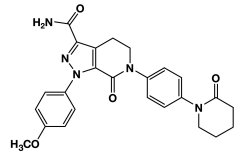
ELIQUIS (apixaban), a factor Xa (FXa) inhibitor, is chemically described as 1-(4-methoxyphenyl)-7-oxo-6-[4-(2-oxopiperidin-1-yl)phenyl]-4,5,6,7-tetrahydro-1H-pyrazolo[3,4-c]pyridine-3-carboxamide. Its molecular formula is C25H25N5O4, which corresponds to a molecular weight of 459.5. Apixaban has the following structural formula:
Apixaban is a white to pale-yellow powder. At physiological pH (1.2-6.8), apixaban does not ionize; its aqueous solubility across the physiological pH range is ~0.04 mg/mL.
ELIQUIS tablets 2.5 mg and 5 mg are available for oral administration and contain the following inactive ingredients: anhydrous lactose, microcrystalline cellulose, croscarmellose sodium, sodium lauryl sulfate, and magnesium stearate. The film coating contains lactose monohydrate, hypromellose, titanium dioxide, triacetin, and yellow iron oxide (2.5 mg tablets) or red iron oxide (5 mg tablets).
ELIQUIS 0.5 mg film coated tablets for oral suspension are supplied in packets containing 1 (0.5 mg), 3 (1.5 mg) or 4 (2 mg) apixaban tablets. The inactive ingredients are anhydrous lactose, microcrystalline cellulose, croscarmellose sodium, sodium lauryl sulfate, and magnesium stearate. The film coating contains lactose monohydrate, hypromellose, titanium dioxide, triacetin, and red iron oxide.
ELIQUIS SPRINKLE 0.15 mg for oral suspension is supplied as a white to off-white powder in capsules, which contain 0.15 mg apixaban and the following inactive ingredients: hypromellose and sugar spheres.

How It Works
Apixaban blocks a clotting protein called FXa. It is selective for FXa.
Apixaban does not need antithrombin III to work against clots.
Apixaban blocks FXa that is free and FXa that is bound in a clot. It also blocks prothrombinase activity.
Apixaban does not directly affect how platelets clump together. But it indirectly blocks platelet clumping that thrombin causes.
By blocking FXa, apixaban lowers thrombin generation and lowers clot growth.
Apixaban is a selective inhibitor of FXa. It does not require antithrombin III for antithrombotic activity. Apixaban inhibits free and clot-bound FXa, and prothrombinase activity. Apixaban has no direct effect on platelet aggregation, but indirectly inhibits platelet aggregation induced by thrombin. By inhibiting FXa, apixaban decreases thrombin generation and thrombus development.
Pharmacodynamics (How It Affects the Body)
Apixaban blocks FXa. This makes some clotting tests take longer. These tests include prothrombin time (PT), INR, and activated partial thromboplastin time (aPTT).
At the usual treatment dose, the changes in these clotting tests are small. The results vary a lot from person to person. These tests are not useful for checking how well apixaban is working to prevent clots.
A test called the Rotachrom Heparin chromogenic assay was used to measure how apixaban affects FXa activity in people. This was mostly done during the adult development program for apixaban.
In the dose range tested, anti-FXa activity went up as the amount of drug went up. This increase was similar in healthy people and in patients with AF.
This test is not recommended for checking the anticoagulant effect of apixaban.
There is no clinical experience with using 4-factor PCC products to reverse bleeding in people who have received ELIQUIS.
The effects of 4-factor PCCs on the pharmacodynamics of apixaban were studied in healthy subjects.
After apixaban was given to reach steady state, endogenous thrombin potential (ETP) returned to pre-apixaban levels 4 hours after the start of a 30-minute PCC infusion. With placebo, ETP returned to pre-apixaban levels at 45 hours.
Mean ETP levels kept going up and went above pre-apixaban levels. They reached a maximum at 21 hours after starting PCC. This was a 34% to 51% increase over pre-apixaban levels. They stayed elevated at the end of the study, 69 hours after starting PCC. This was a 21% to 27% increase.
The clinical relevance of this increase in ETP is unknown.
Pharmacodynamic drug interaction studies were done with aspirin, clopidogrel, aspirin and clopidogrel, prasugrel, enoxaparin, and naproxen.
No pharmacodynamic interactions were seen with aspirin, clopidogrel, or prasugrel.
A 50% to 60% increase in anti-FXa activity was seen when ELIQUIS was given with enoxaparin or naproxen.
Renal impairment: Anti-FXa activity adjusted for exposure to apixaban was similar across renal function categories.
Hepatic impairment: Changes in anti-FXa activity were similar in patients with mild-to-moderate hepatic impairment and healthy subjects. But in patients with moderate hepatic impairment, there is no clear understanding of how this level of liver function impairment affects the coagulation cascade and how that relates to efficacy and bleeding. Patients with severe hepatic impairment were not studied.
Pediatric patients: In pediatric patients treated with apixaban, the correlation between anti-FXa activity and plasma concentration is linear with a slope close to 1.
Apixaban has no effect on the QTc interval in humans at doses up to 50 mg.
As a result of FXa inhibition, apixaban prolongs clotting tests such as prothrombin time (PT), INR, and activated partial thromboplastin time (aPTT). Changes observed in these clotting tests at the expected therapeutic dose, however, are small, subject to a high degree of variability, and not useful in monitoring the anticoagulation effect of apixaban.
The Rotachrom ® Heparin chromogenic assay was used to measure the effect of apixaban on FXa activity in humans primarily during the apixaban adult development program. A concentration-dependent increase in anti-FXa activity was observed in the dose range tested and was similar in healthy subjects and patients with AF.
This test is not recommended for assessing the anticoagulant effect of apixaban.
Effect of PCCs on Pharmacodynamics of ELIQUIS There is no clinical experience to reverse bleeding with the use of 4-factor PCC products in individuals who have received ELIQUIS. Effects of 4-factor PCCs on the pharmacodynamics of apixaban were studied in healthy subjects. Following administration of apixaban dosed to steady state, endogenous thrombin potential (ETP) returned to pre-apixaban levels 4 hours after the initiation of a 30-minute PCC infusion, compared to 45 hours with placebo. Mean ETP levels continued to increase and exceeded pre-apixaban levels reaching a maximum (34%-51% increase over pre-apixaban levels) at 21 hours after initiating PCC and remained elevated (21%-27% increase) at the end of the study (69 hours after initiation of PCC). The clinical relevance of this increase in ETP is unknown.
Pharmacodynamic Drug Interaction Studies Pharmacodynamic drug interaction studies with aspirin, clopidogrel, aspirin and clopidogrel, prasugrel, enoxaparin, and naproxen were conducted. No pharmacodynamic interactions were observed with aspirin, clopidogrel, or prasugrel [see Warnings and Precautions (5.2) ] . A 50% to 60% increase in anti-FXa activity was observed when ELIQUIS was coadministered with enoxaparin or naproxen.
Specific Populations Renal impairment: Anti-FXa activity adjusted for exposure to apixaban was similar across renal function categories. Hepatic impairment: Changes in anti-FXa activity were similar in patients with mild-to-moderate hepatic impairment and healthy subjects. However, in patients with moderate hepatic impairment, there is no clear understanding of the impact of this degree of hepatic function impairment on the coagulation cascade and its relationship to efficacy and bleeding. Patients with severe hepatic impairment were not studied. Pediatric patients: In pediatric patients treated with apixaban, the correlation between anti-FXa activity and plasma concentration is linear with a slope close to 1.
Cardiac Electrophysiology Apixaban has no effect on the QTc interval in humans at doses up to 50 mg.
Pharmacokinetics (What the Body Does to It)
Apixaban shows linear pharmacokinetics. Exposure goes up in proportion to the dose for oral doses up to 10 mg.
Absorption: The absolute bioavailability of apixaban is about 50% for doses up to 10 mg of ELIQUIS. Food does not change the bioavailability of apixaban. The highest levels of apixaban in the blood (Cmax) appear 3 to 4 hours after you take ELIQUIS by mouth. At doses of 25 mg or more, apixaban absorption is limited by how fast it dissolves, so bioavailability goes down.
When 10 mg of apixaban was given by mouth as 2 crushed 5 mg tablets mixed in 30 mL of water, exposure was like that after 2 whole 5 mg tablets by mouth. When 10 mg of apixaban was given by mouth as 2 crushed 5 mg tablets mixed with 30 g of applesauce, the Cmax was 20% lower and the AUC was 16% lower than after 2 whole 5 mg tablets. When a crushed 5 mg ELIQUIS tablet was mixed in 60 mL of D5W and given through a nasogastric tube, exposure was like that seen in other clinical trials in healthy volunteers who took a single 5 mg tablet by mouth.
Distribution: In humans, about 87% of apixaban binds to plasma proteins. The volume of distribution (Vss) is about 21 liters.
Metabolism: About 25% of an apixaban dose taken by mouth is found in urine and feces as metabolites. Apixaban is broken down mainly by CYP3A4. CYP1A2, 2C8, 2C9, 2C19, and 2J2 play minor roles. O-demethylation and hydroxylation at the 3-oxopiperidinyl part are the main sites of breakdown. Unchanged apixaban is the main drug-related part in human plasma. There are no active circulating metabolites.
Elimination: Apixaban leaves the body in both urine and feces. Renal excretion accounts for about 27% of total clearance. Biliary and direct intestinal excretion add to removal of apixaban in the feces. Apixaban has a total clearance of about 3.3 L/hour. After you take it by mouth, the apparent half-life is about 12 hours. Apixaban is a substrate of the transport proteins P-gp and breast cancer resistance protein.
Drug Interaction Studies: In in vitro apixaban studies at concentrations much higher than therapeutic exposures, no lessening of the activity of CYP1A2, CYP2A6, CYP2B6, CYP2C8, CYP2C9, CYP2D6, CYP3A4/5, or CYP2C19 was seen. No increase in the activity of CYP1A2, CYP2B6, or CYP3A4/5 was seen. So apixaban is not expected to change the metabolic clearance of other drugs broken down by these enzymes. Apixaban is not a significant inhibitor of P-gp. The effects of other drugs taken at the same time on the pharmacokinetics of apixaban are summarized in Figure 2 [see also Warnings and Precautions (5.2) and Drug Interactions (7)].
Figure 2: Effect of Coadministered Drugs on the Pharmacokinetics of Apixaban
In dedicated studies in healthy subjects, famotidine, atenolol, prasugrel, and enoxaparin did not meaningfully change the pharmacokinetics of apixaban. In studies in healthy subjects, apixaban did not meaningfully change the pharmacokinetics of digoxin, naproxen, atenolol, prasugrel, or acetylsalicylic acid.
Apixaban demonstrates linear pharmacokinetics with dose-proportional increases in exposure for oral doses up to 10 mg.
Absorption The absolute bioavailability of apixaban is approximately 50% for doses up to 10 mg of ELIQUIS. Food does not affect the bioavailability of apixaban. Maximum concentrations (C max ) of apixaban appear 3 to 4 hours after oral administration of ELIQUIS. At doses ≥25 mg, apixaban displays dissolution-limited absorption with decreased bioavailability. Following oral administration of 10 mg of apixaban as 2 crushed 5 mg tablets suspended in 30 mL of water, exposure was similar to that after oral administration of 2 intact 5 mg tablets. Following oral administration of 10 mg of apixaban as 2 crushed 5 mg tablets mixed with 30 g of applesauce, the C max and AUC were 20% and 16% lower, respectively, when compared to administration of 2 intact 5 mg tablets. Following administration of a crushed 5 mg ELIQUIS tablet that was suspended in 60 mL D5W and delivered through a nasogastric tube, exposure was similar to that seen in other clinical trials involving healthy volunteers receiving a single oral 5 mg tablet dose.
Distribution Plasma protein binding in humans is approximately 87%. The volume of distribution (Vss) is approximately 21 liters.
Metabolism Approximately 25% of an orally administered apixaban dose is recovered in urine and feces as metabolites. Apixaban is metabolized mainly via CYP3A4 with minor contributions from CYP1A2, 2C8, 2C9, 2C19, and 2J2. O-demethylation and hydroxylation at the 3-oxopiperidinyl moiety are the major sites of biotransformation. Unchanged apixaban is the major drug-related component in human plasma; there are no active circulating metabolites.
Elimination Apixaban is eliminated in both urine and feces. Renal excretion accounts for about 27% of total clearance. Biliary and direct intestinal excretion contributes to elimination of apixaban in the feces. Apixaban has a total clearance of approximately 3.3 L/hour and an apparent half-life of approximately 12 hours following oral administration. Apixaban is a substrate of transport proteins: P-gp and breast cancer resistance protein.
Drug Interaction Studies In i n vitro apixaban studies at concentrations significantly greater than therapeutic exposures, no inhibitory effect on the activity of CYP1A2, CYP2A6, CYP2B6, CYP2C8, CYP2C9, CYP2D6, CYP3A4/5, or CYP2C19, nor induction effect on the activity of CYP1A2, CYP2B6, or CYP3A4/5 were observed. Therefore, apixaban is not expected to alter the metabolic clearance of coadministered drugs that are metabolized by these enzymes. Apixaban is not a significant inhibitor of P-gp. The effects of coadministered drugs on the pharmacokinetics of apixaban are summarized in Figure 2 [see also Warnings and Precautions (5.2) and Drug Interactions (7) ] . Figure 2: Effect of Coadministered Drugs on the Pharmacokinetics of Apixaban In dedicated studies conducted in healthy subjects, famotidine, atenolol, prasugrel, and enoxaparin did not meaningfully alter the pharmacokinetics of apixaban. In studies conducted in healthy subjects, apixaban did not meaningfully alter the pharmacokinetics of digoxin, naproxen, atenolol, prasugrel, or acetylsalicylic acid.
Specific Populations The effects of level of renal impairment, age, body weight, and level of hepatic impairment on the pharmacokinetics of apixaban are summarized in Figure 3. Figure 3: Effect of Specific Populations on the Pharmacokinetics of Apixaban * ESRD subjects treated with intermittent hemodialysis; reported PK findings are following single dose of apixaban posthemodialysis. † Results reflect CrCl of 15 mL/min based on regression analysis. ‡ Dashed vertical lines illustrate pharmacokinetic changes that were used to inform dosing recommendations. § No dose adjustment is recommended for nonvalvular atrial fibrillation patients unless at least 2 of the following patient characteristics (age greater than or equal to 80 years, body weight less than or equal to 60 kg, or serum creatinine greater than or equal to 1.5 mg/dL) are present. Gender: A study in healthy subjects comparing the pharmacokinetics in males and females showed no meaningful difference. Race: The results across pharmacokinetic studies in normal subjects showed no differences in apixaban pharmacokinetics among White/Caucasian, Asian, and Black/African American subjects. No dose adjustment is required based on race/ethnicity. Hemodialysis in ESRD subjects: Systemic exposure to apixaban administered as a single 5 mg dose in ESRD subjects dosed immediately after the completion of a 4-hour hemodialysis session (postdialysis) is 36% higher when compared to subjects with normal renal function (Figure 3). The systemic exposure to apixaban administered 2 hours prior to a 4-hour hemodialysis session with a dialysate flow rate of 500 mL/min and a blood flow rate in the range of 350 to 500 mL/min is 17% higher compared to those with normal renal function. The dialysis clearance of apixaban is approximately 18 mL/min. The systemic exposure of apixaban is 14% lower on dialysis when compared to not on dialysis. Protein binding was similar (92%-94%) between healthy controls and ESRD subjects during the on-dialysis and off-dialysis periods. Pediatric Patients: Apixaban reached maximum concentration (C max ) in pediatric patients approximately 2 hours after single-dose administration. In pediatric patients, apixaban has a total apparent clearance of about 3.0 L/h. An exploratory analysis in pediatric patients did not reveal relevant differences in apixaban exposure based on gender or race.
Clinical Studies
Evidence for how well ELIQUIS works and how safe it is comes from ARISTOTLE. ARISTOTLE was a study in many countries. It was double-blind. That means neither the patients nor the doctors knew which drug each patient got. The study looked at patients with nonvalvular AF. It compared ELIQUIS and warfarin. It looked at the risk of stroke and non-central nervous system (CNS) systemic embolism.
In ARISTOTLE, patients were put into groups by chance. One group got ELIQUIS 5 mg by mouth two times a day. Some patients got ELIQUIS 2.5 mg two times a day instead. These were patients who had at least 2 of these traits: age 80 years or older, body weight 60 kg or less, or serum creatinine 1.5 mg/dL or higher. Another group got warfarin. Warfarin was adjusted to keep an INR between 2.0 and 3.0.
Patients also had to have one or more other risk factors for stroke. These risk factors were:
- A stroke or transient ischemic attack (TIA) in the past.
- A systemic embolism in the past.
- Age 75 years or older.
- Arterial hypertension that needed treatment.
- Diabetes mellitus.
- Heart failure of New York Heart Association Class 2 or higher.
- Left ventricular ejection fraction of 40% or less.
The main goal of ARISTOTLE was to find out if ELIQUIS 5 mg two times a day (or 2.5 mg two times a day) worked as well as warfarin. Working as well means noninferior. The study looked at lowering the risk of stroke (ischemic or hemorrhagic) and systemic embolism. The study also looked at whether ELIQUIS was better than warfarin for the main endpoint. The main endpoint was the rate of stroke and systemic embolism. The study also looked at major bleeding and death from any cause.
A total of 18,201 patients were put into groups by chance. Patients were followed on study treatment for a median of 89 weeks. Median means half were followed longer and half were followed for less time. Forty-three percent of patients were vitamin K antagonist (VKA) naive. This means they had taken warfarin or another VKA for 30 days in a row or less before joining the study. The mean age was 69 years. The mean CHADS2 score was 2.1. CHADS2 is a scale from 0 to 6. It is used to estimate the risk of stroke. Higher scores mean greater risk. The population was 65% male, 83% Caucasian, 14% Asian, and 1% Black. Nineteen percent of patients had a history of stroke, TIA, or non-CNS systemic embolism. Other diseases in these patients included hypertension in 88%, diabetes in 25%, congestive heart failure (or left ventricular ejection fraction 40% or less) in 35%, and prior myocardial infarction in 14%. Patients treated with warfarin in ARISTOTLE had a mean time in therapeutic range (INR 2.0-3.0) of 62%.
The ARISTOTLE study included 18,201 patients. They were followed on study treatment for a median of 89 weeks.
The mean age was 69 years. The mean CHADS2 score was 2.1. CHADS2 is a scale from 0 to 6. It estimates stroke risk. Higher scores mean greater risk.
The group was 65% male, 83% Caucasian, 14% Asian, and 1% Black.
Forty-three percent of patients had not taken a vitamin K antagonist (VKA) before. This means they had 30 or fewer days in a row of warfarin or another VKA before the study.
Nineteen percent had a history of stroke, TIA, or non-CNS systemic embolism.
Other diseases in the study group included hypertension in 88%, diabetes in 25%, congestive heart failure (or left ventricular ejection fraction 40% or less) in 35%, and prior myocardial infarction in 14%.
Warfarin patients in ARISTOTLE had a mean time in therapeutic range (INR 2.0-3.0) of 62%.
ELIQUIS was better than warfarin for the primary endpoint of lowering the risk of stroke and systemic embolism.
This benefit was mostly due to fewer hemorrhagic strokes and fewer ischemic strokes with hemorrhagic conversion compared to warfarin.
Purely ischemic strokes happened at similar rates on both drugs.
ELIQUIS also had significantly fewer major bleeds than warfarin.
Table 13 shows key efficacy outcomes in patients with nonvalvular atrial fibrillation in ARISTOTLE. This was an intent-to-treat analysis.
The primary endpoint was based on the time to the first event. There was one event per subject.
Component counts are for subjects with any event. The event was not necessarily the first.
All-cause death was assessed with a sequential testing plan. This plan allowed testing for superiority if effects on earlier endpoints were shown. The earlier endpoints were stroke plus systemic embolus and major bleeding.
ELIQUIS led to a significantly lower rate of all-cause death than warfarin (p = 0.046).
This lower rate was mostly due to fewer cardiovascular deaths, especially stroke deaths.
Non-vascular death rates were similar in both treatment arms.
In ARISTOTLE, results for the primary efficacy endpoint were generally consistent across most major subgroups. These included weight, CHADS2 score, prior warfarin use, level of kidney problems, geographic region, and aspirin use at randomization.
At the end of the ARISTOTLE study, warfarin patients who finished the study were generally kept on a VKA with no break in anticoagulation.
ELIQUIS patients who finished the study were generally switched to a VKA. They took ELIQUIS and VKA together for 2 days.
Some patients may not have had enough anticoagulation after stopping ELIQUIS until they reached a stable and therapeutic INR.
In the 30 days after the study ended, there were 21 stroke or systemic embolism events in the 6791 patients (0.3%) in the ELIQUIS arm.
In the same 30 days, there were 5 stroke or systemic embolism events in the 6569 patients (0.1%) in the warfarin arm.
In AVERROES, patients had nonvalvular atrial fibrillation. They were thought not to be able to take warfarin. They were assigned by chance to ELIQUIS 5 mg by mouth twice daily (or 2.5 mg twice daily in some patients) or aspirin 81 to 324 mg once daily.
The main goal was to find out if ELIQUIS was better than aspirin at preventing the combined outcome of stroke or systemic embolism.
AVERROES was stopped early. A planned interim analysis showed a significant drop in stroke and systemic embolism for ELIQUIS compared to aspirin. This came with a modest increase in major bleeding.
In the AMPLIFY study, about 90% of patients had an unprovoked DVT or PE at the start. The other 10% had a provoked DVT or PE. They also had to have one more ongoing risk factor to join the study. These risk factors were a past DVT or PE, not being able to move, a history of cancer, active cancer, or a known prothrombotic genotype.
In the AMPLIFY study, ELIQUIS was shown to be noninferior to enoxaparin/warfarin. This was for the main endpoint of recurrent symptomatic VTE (nonfatal DVT or nonfatal PE) or VTE-related death over 6 months of therapy (Table 17).
Table 17: Efficacy Results in the AMPLIFY Study
ELIQUIS was noninferior compared to enoxaparin/warfarin (P-value <0.0001). Events for each endpoint were counted once per subject. But subjects may have had events in more than one endpoint.
In the AMPLIFY study, patients were put into groups based on their index event: PE (with or without DVT) or DVT (without PE). Efficacy in the initial treatment of VTE was consistent between the two groups.
In the AMPLIFY-EXT study, patients who had been treated for DVT and/or PE for 6 to 12 months with an anticoagulant and had no recurrent event were randomized to one of three groups for 12 months: ELIQUIS 2.5 mg by mouth twice daily, ELIQUIS 5 mg by mouth twice daily, or placebo. About one-third of patients had taken part in the AMPLIFY study before joining the AMPLIFY-EXT study.
A total of 2482 patients were randomized to study treatment. They were followed for a mean of about 330 days in the ELIQUIS group and about 312 days in the placebo group. The mean age in the AMPLIFY-EXT study was 57 years. The study population was 57% male, 85% Caucasian, 5% Asian, and 3% Black.
The AMPLIFY-EXT study enrolled patients with either an unprovoked DVT or PE at the start (about 92%) or a provoked event at the start plus one more risk factor for recurrence (about 8%). Patients who had multiple episodes of unprovoked DVT or PE were not allowed in the AMPLIFY-EXT study. In the AMPLIFY-EXT study, both doses of ELIQUIS were superior to placebo for the main endpoint of symptomatic, recurrent VTE (nonfatal DVT or nonfatal PE), or death from any cause (Table 18).
Table 18: Efficacy Results in the AMPLIFY-EXT Study
Patients with more than one event are counted in multiple rows.
ELIQUIS for the treatment of venous thromboembolism (VTE) and reduction in the risk of recurrent VTE was evaluated in Study CV185325. This was a multicenter, randomized, active-controlled, open-label study in 229 pediatric patients from birth to less than 18 years with confirmed VTE. This was a descriptive study and no formal inferences were performed. There were 137 patients aged 12 to less than 18 years, 44 patients aged 2 to less than 12 years, 32 patients aged 28 days to less than 2 years, and 16 patients from birth to less than 27 days. Overall, the median age was 14.2 years with a range of 0.04 to 18.0 years. Neonates and infants were not allowed to join if they were less than 34 weeks’ gestation (until age more than 6 months) or had a body weight less than 2.6 kg. For pre-term infants born between 34 and less than 37 weeks gestation, neonates who reached 37 weeks from actual date of birth (postnatal age), from 27 day neonatal period from actual date of birth (postnatal age), or from when the postmenstrual age (gestational age defined as time elapsed between first day of last normal menstrual period and the day of delivery plus postnatal age) and enrolled the neonate no more than 27 days thereafter. There were 101 (44.1%) males and 128 (55.9%) females in the study. One hundred and seventy-five (76.4%) patients were White, 31 (13.5%) were Black, 9 (3.9%) were Asian, 4 (1.7%) were Other, 2 (0.9%) were Multiracial, and 1 (0.4%) was American Indian or Alaska Native, and 7 (3.1%) were missing this information. Twenty-five (10.9%) were Hispanic or Latino and 204 (89.1%) were not Hispanic or Latino.
ELIQUIS was studied for treating venous thromboembolism (VTE) and lowering the risk of VTE coming back. The study was called Study CV185325.
- Study CV185325 included 229 children from birth to less than 18 years old who had confirmed VTE.
- This was a descriptive study. No formal inferences were performed.
- There were 137 patients aged 12 to less than 18 years.
- There were 44 patients aged 2 to less than 12 years.
- There were 32 patients aged 28 days to less than 2 years.
- There were 16 patients from birth to less than 27 days.
- The median age was 14.2 years, with a range of 0.04 to 18.0 years.
- Newborns and infants were not allowed to join if they were born before 34 weeks of pregnancy, until they were older than 6 months.
- Newborns and infants were not allowed to join if they weighed less than 2.6 kg.
- For pre-term infants born between 34 and less than 37 weeks of pregnancy, newborns who reached 37 weeks from their actual date of birth, from a 27-day newborn period starting from their actual date of birth, or from their postmenstrual age were enrolled no more than 27 days after that. Postmenstrual age means the time from the first day of the last normal menstrual period to delivery, plus the age after birth.
- There were 101 males (44.1%).
- There were 128 females (55.9%).
- 175 patients (76.4%) were White.
- 31 patients (13.5%) were Black.
- 9 patients (3.9%) were Asian.
- 4 patients (1.7%) were Other.
- 2 patients (0.9%) were Multiracial.
- 1 patient (0.4%) was American Indian or Alaska Native.
- 7 patients (3.1%) were missing this information.
- 25 patients (10.9%) were Hispanic or Latino.
- 204 patients (89.1%) were not Hispanic or Latino.
- Index VTE was classified as deep venous thrombosis (DVT).
- Index VTE was classified as pulmonary embolism (PE).
- Index VTE was classified as device-related thrombosis, but only in the newborn population.
- Index VTE was classified as other VTE. This includes cerebral vein and sinus thrombosis, renal vein thrombosis, and intracardiac thrombus.
- Before randomization, patients could be treated with standard of care (SOC) anticoagulation for up to 14 days.
- The overall mean (SD) duration of SOC anticoagulation before randomization was 4.9 (2.6) days.
- For 92.9% of patients, the duration of SOC anticoagulation before randomization was between 0 and 7 days.
- Patients were randomized in a 2:1 ratio to receive either ELIQUIS or SOC. ELIQUIS was given as an age-appropriate formulation and body weight-adjusted doses.
- For patients 2 to less than 18 years, SOC was low molecular weight heparins (LMWH), unfractionated heparins (UFH), or vitamin K antagonists (VKA).
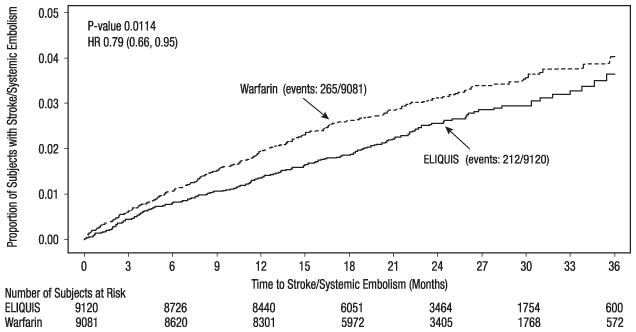
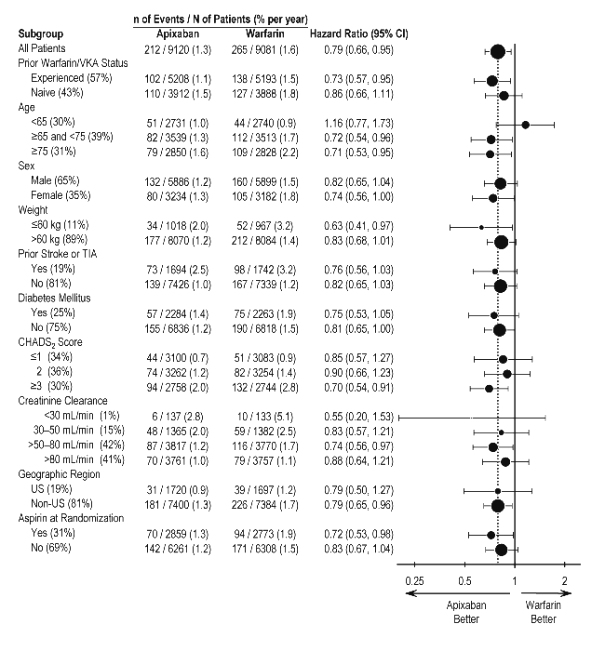
| ELIQUIS
N=9120 n (%/year) |
Warfarin
N=9081 n (%/year) |
Hazard Ratio
(95% CI) |
P-value | |
|---|---|---|---|---|
| The primary endpoint was based on the time to first event (one per subject). Component counts are for subjects with any event, not necessarily the first. | ||||
|
Stroke or systemic embolism |
212 (1.27) |
265 (1.60) |
0.79 (0.66, 0.95) |
0.01 |
|
Stroke |
199 (1.19) |
250 (1.51) |
0.79 (0.65, 0.95) |
|
|
Ischemic without hemorrhage |
140 (0.83) |
136 (0.82) |
1.02 (0.81, 1.29) |
|
|
Ischemic with hemorrhagic conversion |
12 (0.07) |
20 (0.12) |
0.60 (0.29, 1.23) |
|
|
Hemorrhagic |
40 (0.24) |
78 (0.47) |
0.51 (0.35, 0.75) |
|
|
Unknown |
14 (0.08) |
21 (0.13) |
0.65 (0.33, 1.29) |
|
|
Systemic embolism |
15 (0.09) |
17 (0.10) |
0.87 (0.44, 1.75) |
|
| ELIQUIS
N=2807 n (%/year) |
Aspirin
N=2791 n (%/year) |
Hazard Ratio
(95% CI) |
P-value | |
|---|---|---|---|---|
|
Stroke or systemic embolism |
51 (1.62) |
113 (3.63) |
0.45 (0.32, 0.62) |
<0.0001 |
|
Stroke |
||||
|
Ischemic or undetermined |
43 (1.37) |
97 (3.11) |
0.44 (0.31, 0.63) |
– |
|
Hemorrhagic |
6 (0.19) |
9 (0.28) |
0.67 (0.24, 1.88) |
– |
|
Systemic embolism |
2 (0.06) |
13 (0.41) |
0.15 (0.03, 0.68) |
– |
|
MI |
24 (0.76) |
28 (0.89) |
0.86 (0.50, 1.48) |
– |
|
All-cause death |
111 (3.51) |
140 (4.42) |
0.79 (0.62, 1.02) |
0.068 |
|
Vascular death |
84 (2.65) |
96 (3.03) |
0.87 (0.65, 1.17) |
– |
| * Events associated with each endpoint were counted once per subject but subjects may have contributed events to multiple endpoints.
† Total VTE includes symptomatic and asymptomatic DVT and PE. ‡ Includes symptomatic and asymptomatic DVT. |
|||
|
ADVANCE-3 |
|||
|
Events During 35-Day Treatment Period |
ELIQUIS 2.5 mg po bid |
Enoxaparin 40 mg sc qd |
Relative Risk (95% CI) P-value |
|
Number of Patients |
N=1949 |
N=1917 |
|
|
Total VTE†/All-cause death |
27 (1.39%) (0.95, 2.02) |
74 (3.86%) (3.08, 4.83) |
0.36 (0.22, 0.54) p<0.0001 |
|
Number of Patients |
N=2708 |
N=2699 |
|
|
All-cause death |
3 (0.11%) (0.02, 0.35) |
1 (0.04%) (0.00, 0.24) |
|
|
PE |
3 (0.11%) (0.02, 0.35) |
5 (0.19%) (0.07, 0.45) |
|
|
Symptomatic DVT |
1 (0.04%) (0.00, 0.24) |
5 (0.19%) (0.07, 0.45) |
|
|
Number of Patients |
N=2196 |
N=2190 |
|
|
Proximal DVT‡ |
7 (0.32%) (0.14, 0.68) |
20 (0.91%) (0.59, 1.42) |
|
|
Number of Patients |
N=1951 |
N=1908 |
|
|
Distal DVT‡ |
20 (1.03%) (0.66, 1.59) |
57 (2.99%) (2.31, 3.86) |
|
| ADVANCE-1 | ADVANCE-2 | |||||
|---|---|---|---|---|---|---|
| * Events associated with each endpoint were counted once per subject but subjects may have contributed events to multiple endpoints.
† Total VTE includes symptomatic and asymptomatic DVT and PE. ‡ Includes symptomatic and asymptomatic DVT. |
||||||
|
Events during 12-day treatment period |
ELIQUIS 2.5 mg po bid |
Enoxaparin 30 mg sc q12h |
Relative Risk (95% CI) P-value |
ELIQUIS 2.5 mg po bid |
Enoxaparin 40 mg sc qd |
Relative Risk (95% CI) P-value |
|
Number of Patients |
N=1157 |
N=1130 |
N=976 |
N=997 |
||
|
Total VTE†/All-cause death |
104 (8.99%) (7.47, 10.79) |
100 (8.85%) (7.33, 10.66) |
1.02 (0.78, 1.32) NS |
147 (15.06%) (12.95, 17.46) |
243 (24.37%) (21.81, 27.14) |
0.62 (0.51, 0.74) p<0.0001 |
|
Number of Patients |
N=1599 |
N=1596 |
N=1528 |
N=1529 |
||
|
All-cause death |
3 (0.19%) (0.04, 0.59) |
3 (0.19%) (0.04, 0.59) |
2 (0.13%) (0.01, 0.52) |
0 (0%) (0.00, 0.31) |
||
|
PE |
16 (1.0%) (0.61, 1.64) |
7 (0.44%) (0.20, 0.93) |
4 (0.26%) (0.08, 0.70) |
0 (0%) (0.00, 0.31) |
||
|
Symptomatic DVT |
3 (0.19%) (0.04, 0.59) |
7 (0.44%) (0.20, 0.93) |
3 (0.20%) (0.04, 0.61) |
7 (0.46%) (0.20, 0.97) |
||
|
Number of Patients |
N=1254 |
N=1207 |
N=1192 |
N=1199 |
||
|
Proximal DVT‡ |
9 (0.72%) (0.36, 1.39) |
11 (0.91%) (0.49, 1.65) |
9 (0.76%) (0.38, 1.46) |
26 (2.17%) (1.47, 3.18) |
||
|
Number of Patients |
N=1146 |
N=1133 |
N=978 |
N=1000 |
||
|
Distal DVT‡ |
83 (7.24%) (5.88, 8.91) |
91 (8.03%) (6.58, 9.78) |
142 (14.52%) (12.45, 16.88) |
239 (23.9%) (21.36, 26.65) |
||
| ELIQUIS
N=2609 n |
Enoxaparin/Warfarin
N=2635 n |
Relative Risk
(95% CI) |
|
|---|---|---|---|
| * Noninferior compared to enoxaparin/warfarin (P-value <0.0001).
† Events associated with each endpoint were counted once per subject, but subjects may have contributed events to multiple endpoints. |
|||
|
VTE or VTE-related death* |
59 (2.3%) |
71 (2.7%) |
0.84 (0.60, 1.18) |
|
DVT† |
22 (0.8%) |
35 (1.3%) |
|
|
PE† |
27 (1.0%) |
25 (0.9%) |
|
|
VTE-related death† |
12 (0.4%) |
16 (0.6%) |
|
|
VTE or all-cause death |
84 (3.2%) |
104 (4.0%) |
0.82 (0.61, 1.08) |
|
VTE or CV-related death |
61 (2.3%) |
77 (2.9%) |
0.80 (0.57, 1.11) |
| Relative Risk (95% CI) | |||||
|---|---|---|---|---|---|
| ELIQUIS
2.5 mg bid N=840 |
ELIQUIS
5 mg bid N=813 |
Placebo
N=829 |
ELIQUIS
2.5 mg bid vs Placebo |
ELIQUIS
5 mg bid vs Placebo |
|
|
n (%) |
|||||
|
Recurrent VTE or all-cause death |
32 (3.8) |
34 (4.2) |
96 (11.6) |
0.33 (0.22, 0.48) p<0.0001 |
0.36 (0.25, 0.53) p<0.0001 |
|
DVT* |
19 (2.3) |
28 (3.4) |
72 (8.7) |
||
|
PE* |
23 (2.7) |
25 (3.1) |
37 (4.5) |
||
|
All-cause death |
22 (2.6) |
25 (3.1) |
33 (4.0) |
||
| * Recurrent VTE, defined as either contiguous progression or non-contiguous new thrombus and including, but not limited to DVT, PE and paradoxical embolism. | ||
| (1) 95% Confidence Interval calculated using the Clopper-Pearson exact method | ||
| ** UFH/LMWH for patients less than 2 years of age and UFH/LMWH/VKA for those equal to or greater than 2 years of age. | ||
| *** no VTE related mortality was observed in either treatment arms during the study. | ||
|
ELIQUIS N=155
|
Standard of care ** N=74
|
|
|
Symptomatic and asymptomatic recurrent VTE* and VTE* related mortality*** |
||
|
Number (%) Subjects with Event |
4 (2.6) |
2 (2.7) |
|
95% Confidence Interval (1) |
(0.7, 6.5) |
(0.3, 9.4) |
14.1 Reduction of Risk of Stroke and Systemic Embolism in Nonvalvular Atrial Fibrillation
ARISTOTLE
Evidence for the efficacy and safety of ELIQUIS was derived from ARISTOTLE, a multinational, double-blind study in patients with nonvalvular AF comparing the effects of ELIQUIS and warfarin on the risk of stroke and non-central nervous system (CNS) systemic embolism. In ARISTOTLE, patients were randomized to ELIQUIS 5 mg orally twice daily (or 2.5 mg twice daily in subjects with at least 2 of the following characteristics: age greater than or equal to 80 years, body weight less than or equal to 60 kg, or serum creatinine greater than or equal to 1.5 mg/dL) or to warfarin (targeted to an INR range of 2.0-3.0). Patients had to have one or more of the following additional risk factors for stroke:
• prior stroke or transient ischemic attack (TIA)
• prior systemic embolism
• age greater than or equal to 75 years
• arterial hypertension requiring treatment
• diabetes mellitus
• heart failure ≥New York Heart Association Class 2
• left ventricular ejection fraction ≤40%
The primary objective of ARISTOTLE was to determine whether ELIQUIS 5 mg twice daily (or 2.5 mg twice daily) was effective (noninferior to warfarin) in reducing the risk of stroke (ischemic or hemorrhagic) and systemic embolism. Superiority of ELIQUIS to warfarin was also examined for the primary endpoint (rate of stroke and systemic embolism), major bleeding, and death from any cause.
A total of 18,201 patients were randomized and followed on study treatment for a median of 89 weeks. Forty-three percent of patients were vitamin K antagonist (VKA) “naive,” defined as having received ≤30 consecutive days of treatment with warfarin or another VKA before entering the study. The mean age was 69 years and the mean CHADS2 score (a scale from 0 to 6 used to estimate risk of stroke, with higher scores predicting greater risk) was 2.1. The population was 65% male, 83% Caucasian, 14% Asian, and 1% Black. There was a history of stroke, TIA, or non-CNS systemic embolism in 19% of patients. Concomitant diseases of patients in this study included hypertension 88%, diabetes 25%, congestive heart failure (or left ventricular ejection fraction ≤40%) 35%, and prior myocardial infarction 14%. Patients treated with warfarin in ARISTOTLE had a mean percentage of time in therapeutic range (INR 2.0-3.0) of 62%.
| ELIQUIS N=9120 n (%/year) |
Warfarin N=9081 n (%/year) |
Hazard Ratio (95% CI) |
P-value | |
|---|---|---|---|---|
| The primary endpoint was based on the time to first event (one per subject). Component counts are for subjects with any event, not necessarily the first. | ||||
|
Stroke or systemic embolism |
212 (1.27) |
265 (1.60) |
0.79 (0.66, 0.95) |
0.01 |
|
Stroke |
199 (1.19) |
250 (1.51) |
0.79 (0.65, 0.95) |
|
|
Ischemic without hemorrhage |
140 (0.83) |
136 (0.82) |
1.02 (0.81, 1.29) |
|
|
Ischemic with hemorrhagic conversion |
12 (0.07) |
20 (0.12) |
0.60 (0.29, 1.23) |
|
|
Hemorrhagic |
40 (0.24) |
78 (0.47) |
0.51 (0.35, 0.75) |
|
|
Unknown |
14 (0.08) |
21 (0.13) |
0.65 (0.33, 1.29) |
|
|
Systemic embolism |
15 (0.09) |
17 (0.10) |
0.87 (0.44, 1.75) |
|
| ELIQUIS N=2807 n (%/year) |
Aspirin N=2791 n (%/year) |
Hazard Ratio (95% CI) |
P-value | |
|---|---|---|---|---|
|
Stroke or systemic embolism |
51 (1.62) |
113 (3.63) |
0.45 (0.32, 0.62) |
<0.0001 |
|
Stroke |
||||
|
Ischemic or undetermined |
43 (1.37) |
97 (3.11) |
0.44 (0.31, 0.63) |
– |
|
Hemorrhagic |
6 (0.19) |
9 (0.28) |
0.67 (0.24, 1.88) |
– |
|
Systemic embolism |
2 (0.06) |
13 (0.41) |
0.15 (0.03, 0.68) |
– |
|
MI |
24 (0.76) |
28 (0.89) |
0.86 (0.50, 1.48) |
– |
|
All-cause death |
111 (3.51) |
140 (4.42) |
0.79 (0.62, 1.02) |
0.068 |
|
Vascular death |
84 (2.65) |
96 (3.03) |
0.87 (0.65, 1.17) |
– |
| * Events associated with each endpoint were counted once per subject but subjects may have contributed events to multiple endpoints. † Total VTE includes symptomatic and asymptomatic DVT and PE. ‡ Includes symptomatic and asymptomatic DVT. |
|||
|
ADVANCE-3 |
|||
|
Events During 35-Day Treatment Period |
ELIQUIS |
Enoxaparin |
Relative Risk |
|
Number of Patients |
N=1949 |
N=1917 |
|
|
Total VTE†/All-cause death |
27 (1.39%) |
74 (3.86%) |
0.36 |
|
Number of Patients |
N=2708 |
N=2699 |
|
|
All-cause death |
3 (0.11%) |
1 (0.04%) |
|
|
PE |
3 (0.11%) |
5 (0.19%) |
|
|
Symptomatic DVT |
1 (0.04%) |
5 (0.19%) |
|
|
Number of Patients |
N=2196 |
N=2190 |
|
|
Proximal DVT‡ |
7 (0.32%) |
20 (0.91%) |
|
|
Number of Patients |
N=1951 |
N=1908 |
|
|
Distal DVT‡ |
20 (1.03%) |
57 (2.99%) |
|
| ADVANCE-1 | ADVANCE-2 | |||||
|---|---|---|---|---|---|---|
| * Events associated with each endpoint were counted once per subject but subjects may have contributed events to multiple endpoints. † Total VTE includes symptomatic and asymptomatic DVT and PE. ‡ Includes symptomatic and asymptomatic DVT. |
||||||
|
Events during |
ELIQUIS |
Enoxaparin |
Relative Risk |
ELIQUIS |
Enoxaparin qd |
Relative Risk P-value |
|
Number of Patients |
N=1157 |
N=1130 |
N=976 |
N=997 |
||
|
Total VTE†/All-cause death |
104 (8.99%) |
100 (8.85%) |
1.02 |
147 (15.06%) |
243 (24.37%) |
0.62 |
|
Number of Patients |
N=1599 |
N=1596 |
N=1528 |
N=1529 |
||
|
All-cause death |
3 (0.19%) |
3 (0.19%) |
2 (0.13%) |
0 (0%) |
||
|
PE |
16 (1.0%) |
7 (0.44%) |
4 (0.26%) |
0 (0%) |
||
|
Symptomatic |
3 (0.19%) |
7 (0.44%) |
3 (0.20%) |
7 (0.46%) |
||
|
Number of Patients |
N=1254 |
N=1207 |
N=1192 |
N=1199 |
||
|
Proximal DVT‡ |
9 (0.72%) |
11 (0.91%) |
9 (0.76%) |
26 (2.17%) |
||
|
Number of Patients |
N=1146 |
N=1133 |
N=978 |
N=1000 |
||
|
Distal DVT‡ |
83 (7.24%) |
91 (8.03%) |
142 (14.52%) |
239 (23.9%) |
||
| ELIQUIS N=2609 n |
Enoxaparin/Warfarin N=2635 n |
Relative Risk (95% CI) |
|
|---|---|---|---|
| * Noninferior compared to enoxaparin/warfarin (P-value <0.0001). † Events associated with each endpoint were counted once per subject, but subjects may have contributed events to multiple endpoints. |
|||
|
VTE or VTE-related death* |
59 (2.3%) |
71 (2.7%) |
0.84 (0.60, 1.18) |
|
DVT† |
22 (0.8%) |
35 (1.3%) |
|
|
PE† |
27 (1.0%) |
25 (0.9%) |
|
|
VTE-related death† |
12 (0.4%) |
16 (0.6%) |
|
|
VTE or all-cause death |
84 (3.2%) |
104 (4.0%) |
0.82 (0.61, 1.08) |
|
VTE or CV-related death |
61 (2.3%) |
77 (2.9%) |
0.80 (0.57, 1.11) |
| Relative Risk (95% CI) | |||||
|---|---|---|---|---|---|
| ELIQUIS 2.5 mg bid N=840 |
ELIQUIS 5 mg bid N=813 |
Placebo
N=829 |
ELIQUIS 2.5 mg bid vs Placebo |
ELIQUIS 5 mg bid vs Placebo |
|
|
n (%) |
|||||
|
Recurrent VTE or all-cause death |
32 (3.8) |
34 (4.2) |
96 (11.6) |
0.33 (0.22, 0.48) |
0.36 (0.25, 0.53) |
|
DVT* |
19 (2.3) |
28 (3.4) |
72 (8.7) |
||
|
PE* |
23 (2.7) |
25 (3.1) |
37 (4.5) |
||
|
All-cause death |
22 (2.6) |
25 (3.1) |
33 (4.0) |
||
| * Recurrent VTE, defined as either contiguous progression or non-contiguous new thrombus and including, but not limited to DVT, PE and paradoxical embolism. | ||
| (1) 95% Confidence Interval calculated using the Clopper-Pearson exact method | ||
| ** UFH/LMWH for patients less than 2 years of age and UFH/LMWH/VKA for those equal to or greater than 2 years of age. | ||
| *** no VTE related mortality was observed in either treatment arms during the study. | ||
|
ELIQUIS |
Standard of care ** |
|
|
Symptomatic and asymptomatic recurrent VTE* and VTE* related mortality*** |
||
|
Number (%) Subjects with Event |
4 (2.6) |
2 (2.7) |
|
95% Confidence Interval (1) |
(0.7, 6.5) |
(0.3, 9.4) |


Information for Patients
Read the FDA-approved patient labeling. This includes the Medication Guide and Instructions for Use.
- Do not stop taking ELIQUIS without talking to your doctor first.
- It may take longer than usual for bleeding to stop. You may bruise or bleed more easily while taking ELIQUIS.
- Learn how to spot bleeding or signs of low blood volume. Tell your doctor right away about any unusual bleeding.
- Tell your doctors and dentists you take ELIQUIS. Also tell them about any other product that can affect bleeding. This includes products you can buy without a prescription, like aspirin or NSAIDs. Do this before any surgery or medical or dental procedure is scheduled. Do this before you start any new drug.
- If you are having neuraxial anesthesia or a spinal puncture, watch for signs and symptoms of spinal or epidural hematomas. If any of these symptoms happen, get emergency medical care right away.
- Tell your doctor if you are pregnant or plan to become pregnant. Tell your doctor if you are breastfeeding or plan to breastfeed. Do this during treatment with ELIQUIS.
- Ask how to take ELIQUIS if you cannot swallow or need a nasogastric tube.
- Ask what to do if you miss a dose.
Caregivers and patients should also know the following.
- Always give this medicine exactly as the child’s doctor or pharmacist has instructed.
- Keep all scheduled doctor visits. ELIQUIS dose is based on body weight. The dose may need to change as the child’s weight changes. This makes sure the child gets the right dose of ELIQUIS. The doctor may adjust the child’s dose when needed. Caregivers should not adjust the dose themselves.
- Know what to do if the child vomits or spits up. If a child vomits or spits up within 30 minutes after taking ELIQUIS, repeat the dose. If a child vomits or spits up more than 30 minutes after taking ELIQUIS, do not repeat the dose. Give the next ELIQUIS dose at the next scheduled time. Contact the doctor if the child repeatedly vomits or spits up after taking ELIQUIS.
Advise patients to read the FDA-approved patient labeling (Medication Guide and Instructions for Use).
Advise patients of the following:
• Not to discontinue ELIQUIS without talking to their physician first.
• That it might take longer than usual for bleeding to stop, and they may bruise or bleed more easily when treated with ELIQUIS. Advise patients about how to recognize bleeding or symptoms of hypovolemia and of the urgent need to report any unusual bleeding to their physician.
• To tell their physicians and dentists they are taking ELIQUIS, and/or any other product known to affect bleeding (including nonprescription products, such as aspirin or NSAIDs), before any surgery or medical or dental procedure is scheduled and before any new drug is taken.
• If the patient is having neuraxial anesthesia or spinal puncture, inform the patient to watch for signs and symptoms of spinal or epidural hematomas [see Warnings and Precautions (5.3) ]. If any of these symptoms occur, advise the patient to seek emergent medical attention.
• To tell their physicians if they are pregnant or plan to become pregnant or are breastfeeding or intend to breastfeed during treatment with ELIQUIS [see Use in Specific Populations (8.1 , 8.2) ].
• How to take ELIQUIS if they cannot swallow or require a nasogastric tube [see Dosage and Administration (2.7) ].
• What to do if a dose is missed [see Dosage and Administration (2.2 and 2.3) ].
Pediatric Patients
Advise the caregiver or the patient of the following:
• To always give this medicine exactly as the child’s physician or pharmacist has instructed them.
• The importance of keeping scheduled physician’s visits. ELIQUIS dose is based on body weight and the dose may need to be adjusted as the child’s weight changes. This ensures that the child receives the correct dose of ELIQUIS. The physician may adjust the child’s dose when needed. The caregiver should be advised not to adjust the dose themselves.
• What to do if the child vomits or spits up. If a child vomits or spits up within 30 minutes after taking ELIQUIS, repeat the dose. If a child vomits or spits up more than 30 minutes after taking ELIQUIS, do not repeat the dose. Continue to give the next ELIQUIS dose at the next scheduled time. The caregiver should contact the physician if the child repeatedly vomits or spits up after taking ELIQUIS.
Related Medications
Treats These Conditions
This medication is not currently linked to any conditions.
References
ELIQUIS (apixaban) [prescribing information]. September 2026. Available at: https://dailymed.nlm.nih.gov/dailymed/drugInfo.cfm?setid=e9481622-7cc6-418a-acb6-c5450daae9b0
Accessed: October 29, 2026
This medication information was simplified from the official drug label and checked before it was published. Read our simplification promise.